Showing posts with label 16 Days Campaign. Show all posts

Saturday, December 10, 2022

Day 15: Love, Honour and Law: A roundtable on draft legislation on crimes in the name of honour

On December 9, 2022, 15th day of the 2022 Prajnya 16 Days Campaign Against Gender Violence hosted an online roundtable discussion on the draft bill on 'Prevention of Crimes in the Name of Honour' that is being shared by Vincent Raj K. for debate in the Tamil Nadu Assembly. Seeing this as a national issue, a panel of discussants from around India was invited. Shalin Maria Lawrence facilitated the session. You may find a saved copy of the recording here.

"As a person from the marginalised community, the Dalit community, Tamil Nadu has been a welfare state more than a progressive state, in terms of state. And, I talk with data - we have the social and economic indicators.", said Shalin Maria Lawrence, as she opened the discussion. She added that, "If you compare with the honour killings in UP, Madhya Pradesh, or in the northern parts of the Hindi belt of India, the nation does not know the number of honour crimes which happen in Tamil Nadu. For example, the inter-caste marriages is only 1%, or less than 1% in Tamil Nadu. You can call yourself a Periyar land, or a very progressive state, but then, why is your inter-caste percentage very, very less? So, the amount of inter-caste marriages is directly proportional to the violence happening on inter-caste couples."


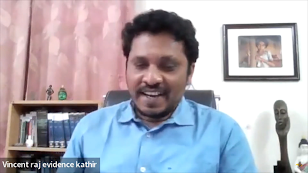
Kathir Vincent Raj, Evidence:

  • "Honour crimes are taking place all over India. Honour killing, honour torture, honour humiliation, mob violence for the sake of arrogance, etc are taking place here. I would like to begin by thinking loudly and raising a question on our usage of the term honour. We call honour crimes as honour crimes because they are committed with an aim to protecting the honour of the family...I think it is time we shake this regressive idea from its roots and rather call it dishonourable."
  • "This bill, first and foremost, seeks to offer protection against victimisation in the name of honour. In the instance of such a crime, the bill outlines the extent of punishment to be given to the perpetrators and the compensation and rehabilitation to be given to the survivors. It also details the protective measures to be implemented, apart from detailing the various kinds of victimisation like murder, social and economic boycotts."
  • "I am pointing out that not just caste but patriarchy also plays a role in the killing in the name of honour; this draft bill is also about gender justice."

Abirami Jotheeswaran:

  • "Coming back to patriarchy, I would like to link it to caste and gender hegemony - how is this impacted? We all know that there is intersectionality in terms of caste and gender. Here, Dalit women are at the bottom. They don't have any rights or privilege, and if they are involved in these activities, then, we have been seeing lot of cases of murders, not just in Tamil Nadu, but all over the country."
  • "In reality, (we have to see) how many cases are reported, how many cases are suicide cases, so many cases are made to be an attempt to rape and has been booked under false charges. These are the situations that I would like to point out."
  • "I would like to give some suggestions (on the draft bill). One is mental trauma. Whatever the shelter home the woman is accessing, the status of the mind is very, very bad. They (women) cannot trust anyone. When parents become the culprits, then definitely they cannot believe anybody. So the mental trauma - how to handle it, how to counsel them, these aspects have to be covered. Secondly, police inaction. Police is not acting and taking the bribe...When there is negligence in the duty of the police, there should be some punitive measure...And, I would also say that there should be a national authority who are taking up the monitoring and better implementation of these kinds of legislations. So, I would like to focus on these three things."

Suresh V:
  • "The role of culture and the role of patriarchy gets intertwined with gender identities. And, how this plays a very, very big role in whether a person can live or now, and how they can live, and how they will have to survive. And that is at the bottom of the issue underlying the larger issue of honour killings."
  • "Fundamental to the issue we are talking about is the issue of choice. The choice exhibits itself in multiple ways."
  • "We need to look at this law a little bit more carefully in terms of what has worked and what has not worked with regard to SC and ST (POA) Act."

Dr. Manisha Gupte:

  • "I just want to say this loud and clear, that a victim can never be theirs. And the rapist can never be ours. But imagine, when rape happens, people take that position. Now imagine when a girl or a boy marries against the wishes of the family."
  • "In a country, the mere identity itself can become a point to kill, that itself allows punishment, that itself allows punishment by the police...So we know just the identity can be an issue. So then, what happens when you exercise your choice? To do something further by saying I am associating with someone who is from this identity? So then, we have to go to the basic question of identity...Identity comes as a part of our mobility from a very controlling system where nobody in the family has an identity except the patriarch."


--

Shalin Maria Lawrence (Moderator): Shalin Maria Lawrence is a social activist, Intersectional feminist, writer and orator. Belong to the oppressed community, she has been working towards empowering the Dalit Women and LGBTQ+ since 2012. She has worked with the Transgenders Rights Organization and has won the "Day of compassion" award from the Jane Goodall foundation. She has been working with the Dalit communities of the north Madras region, especially in and around Vyasarpadi where I has helped in the setting up of libraries, conducting campaigns and awareness programs towards Education and child rights from 2015. She has also been working with the Dalit women and children in the Dharavi Region of Mumbai since 2016. She has set up a library and has been conducting awareness workshops on women's rights and leadership and the annihilation of caste. For the last two years, she has been conducting regular workshops and training on violence on women, women rights and women leadership among the rural dalit women in and around Madurai and Chennai. She is a writer in English and Tamil and currently publishes her articles in popular magazines and news websites.

Kathir Vincent Raj (Presenter): Kathir Vincent Raj has been working in the field of human rights for over 25 years. A Dalit himself, his witnessing and experiencing caste based discrimination from his childhood triggered his determination to fight against the caste system and caste based atrocities against Dalits. From an initial career as a writer on the experiences of the socially marginalized, he later shifted to rights based interventions, especially human rights monitoring and legal and advocacy interventions. This work experience and a commitment to Dalit rights eventually led him to initiate an independent organization, Evidence in 2005 to fight against caste discrimination and for social justice and equality.

Ms. Abirami Jotheeswaran (Discussant) has been associated with National Campaign on Dalit Human Rights-NCDHR, New Delhi, India since December 2005. Presently Ms. Abirami Jotheeswaran has been serving as the General Secretary of All India Dalit Mahila Adhikar Manch-NCDHR, New Delhi. She herself hails from Dalit Community, very actively involved and committed towards the empowerment of Dalit community. Abirami is a post graduated in Computer Science from University of Madras. Currently, she is pursuing her final year Law degree. Placing her in the organization, her primary responsibilities is to Plan, Monitor and Execute Programs related to Promotion of Dalit Women Leadership and Addressing Violence against Dalit women and minor girls in 7 States across the country. At the international level Abirami Jotheeswaran participated in World Social Forum 2007 held at Nairobi, Kenya and South Africa in 2007, to raise the Dalit concern in the forums. She raised her concern on the Police atrocities committed against Dalits and Dalit Women in 18th EU-NGO Human Rights Forum 2016, Brussels. Abirami Jotheeswaran, actively raised the issues related to Violence against Dalit women and the impunity subsists in India in the 41st UN HR Council at Geneva in the month of July 2019. Under her leadership, AIDMAM recently published a Status Report 2021 - “Dalit Women Rise for Justice” with the confidence that the report will be useful to the government while taking steps to improve Dalit Women’s condition in India through effective implementation of the existing Acts and policies.

V Suresh (Discussant): V. Suresh is a lawyer, Madras High Court; National General Secretary, People's Union for Civil Liberties (PUCL) one of Indias' oldest and largest national level human rights organisation. Earlier served as Supreme Court appointed Adviser on Food Security for Tamil Nadu. Worked for 7 years as a full time activist with the Kashtakari Sanghatana (in Maharashtra) amongst Warli Adivasi marginal farmers and agricultural labourers. Recently appeared in Kannagi - Murugesan Honour Killing case for murdered Dalit Murugesan's family before the Madras High Court.  On June 6th, 2022, the Madras HC confirmed the conviction of Kannagi's father, brother and other relatives belonging to Caste Hindu community invovled with the killing, though the HC commuted the death penalty of brother to life sentence.

Dr. Manisha Gupte (Discussant): Dr. Manisha Gupte has been part of the women's movement in India since the mid 1970s; She has also been an activist in the health and civil rights movements. She studied Microbiology (MSc) and then, Sociology. Her PhD thesis was on the concept and practices of patriarchal honour, and how it intersects with caste, sexuality, violence and the agency of subordinated women. She co-founded MASUM, a rural women's organisation in 1987, after living in a drought prone rural area for five years, and has been its co-convenor since then. She spent one year (1997-98) in the Dept. of International Health at the Johns Hopkins University, Baltimore as a visiting fellow. She is actively associated with progressive organisations nationally, regionally and internationally as an advisor, board member or trainer (especially on gender, violence, sexuality, CEDAW and ESC rights). She has participated in, and promoted campaigns related to women's health; reproductive, sexual and minority rights; and, violence against women. She has worked on policy issues with the state and central governments in India over the past three decades. She is the Managing Trustee of Medico Friend Circle (MFC), a 40 year old autonomous health professionals’ group in India, and was the coordinator of the '10th International Women and Health Meeting (IWHM)', held in New Delhi in September 2005. She also coordinated the process towards the preparation of 'The Indian Women’s Health Charter'. She has co-edited a book (2102) titled ‘Honour’ and Women’s Rights: South Asian Perspectives. This book includes 15 papers, highlighting complementary feminist positions from seven countries.


Wednesday, December 7, 2022

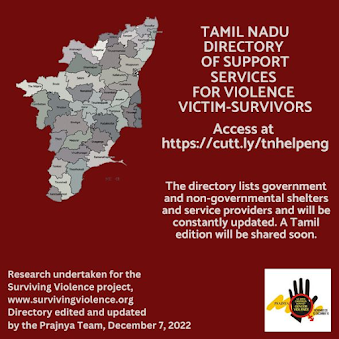
Day 13: Tamil Nadu Domestic Violence Support Services: A Mapping

We are pleased to bring you a new Prajnya resource: the Tamil Nadu Directory of Support Services for Violence Victim-Survivors. This data was compiled for a mapping exercise of the Surviving Violence project (http://survivingviolence.org) and has been edited and updated by the Prajnya Team. At present, the directory includes information about five categories of support services for victim-survivors of violence, namely:

1. Swadhar Home

2. Family Counselling Centres

3. One Stop Centres

4. Protection Officers

5. All Women Police Stations


We will continue to add, update and will share a Tamil version soon. In the interim, do use and share the Directory at https://cutt.ly/tnhelpeng Thank you!

Day 12: Ensuring Access to Reproductive Choice: A Workshop || @drumaram_ram @Archytypes @swarraj @sudaroliacr @Shakthi_2016

Prepared with notes from Dr. S. Shakthi.

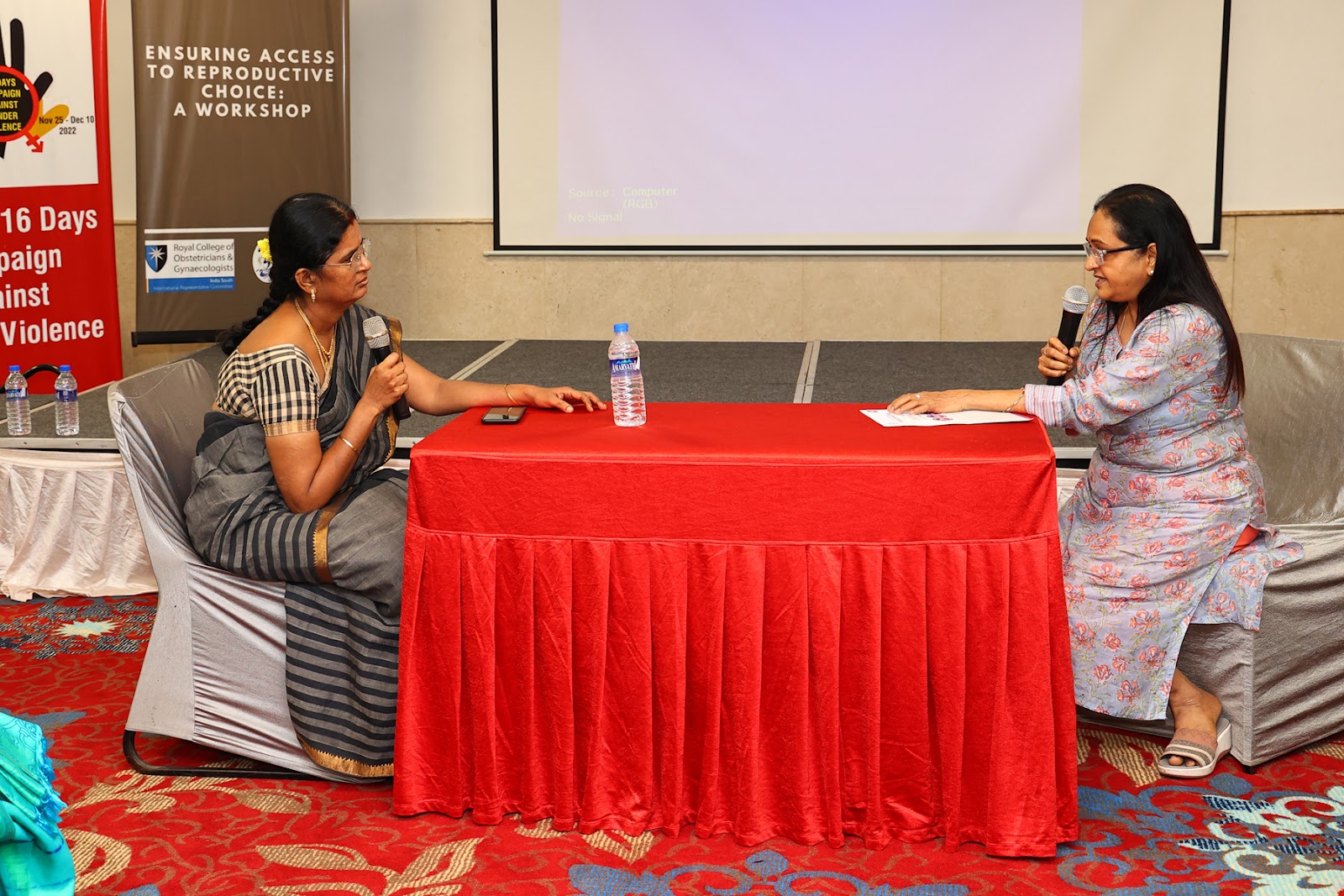
On the 12th day of the 2022 Prajnya 16 Days Campaign Against Gender Violence, we organised an interactive panel discussion, where Dr. Uma Ram, Dr. Prabha Swaminathan, Dr. Jaishree Gajaraj and Archanaa Sekar discussed issues related to sexual and reproductive health rights from the point of view of health care providers. In partnership with ATNRCOG and IRC India South, the 3-hour long event, Ensuring Access to Reproductive Choice: A Workshop" was conducted at Savera Hotel, Chennai.

The topics addressed in the workshop were Sexual and Reproductive Health and Rights (SRHR), Abortion, Domestic Violence and Intimate Partner Violence. The discussions aimed at focussing on how professionals in the medical field would respond to scenarios on the aforementioned themes. Dr. Uma Ram and Dr. Jaishree Gajaraj opened the workshop by discussing abortion, particularly on how to handle cases that may make the role of the doctor complicated, like cases involving minors, which may be filed under POSCO. They supplemented their discussion with several concrete examples of cases they have witnessed. The doctors, during the workshop, acknowledged that regardless of one's personal belief on topics like SRHR and abortion, it is essential for a medical professional to follow the law. The law, here, explicitly states that abortion is a right, which was emphasised throughout the discussion.


In the next hour, Archanaa Seker looked into the theme of access to contraception. She took the audience through an understanding of the ground reality of accessing contraception - in terms of the material, cultural and economic barriers. She mentioned that it is essential to shift the focus to not just look at individuals dealing with the possibility of getting pregnant, but to also look into what people's sexual practices are, what their reproductive choices are and what the overarching conditions for the same may be. The availability of Emergency Contraceptive Pills (ECPs) was also discussed. This discussion was insightful for doctors as it provided them with an understanding of what happens on-ground.


Additionally, during the course of the session, Dr. Swarna Rajagopalan (Prajnya) provided the audience with an understanding of what domestic violence is - that it goes beyond physical and sexual violence, and can also be economic and emotional violence. Dr. Prabha Swaminathan accompanied this conversation with her insights on how the medical fraternity must respond when a patient who has faced domestic violence approaches you, and reflected on the theme through her experiences as an OBGYN. The speakers also touched upon the need to be mindful of the language that is used while communicating with victims-survivors of domestic violence.


In the last hour, role plays were conducted by seven doctors:

1. A doctor and patient - A case of an unmarried woman wanting an abortion.

2. A doctor and patient - A case of a woman who comes in with two children (one of them is less than a year old), and she is pregnant again. She does not want another child, and does not want her family to know that she is getting an abortion.

3. A doctor, a patient and a husband who is abusive - Dealing with domestic violence, especially when the abuser might be in the same room as the patient.


The role plays were done in two segments where one version showed how the doctors must not respond, and all the things that must not be said/done. The other version looked into how the doctors must respond, and the importance of ensuring that their actions are empathetic and supportive.

Monday, December 5, 2022

Day 10: Community Cafe

Rapporteur: Sudaroli Ramasamy

It was Sunday evening when I reached the Better World Shelter for Women with Disabilities at Royapettah. The two things lingering in my mind before I started the conversation with the residents of the shelter home were:

1. The precautions that I need to take care of while I am bringing up the conversation for the Community Cafe. Because I do not want to trigger them at any point of time during the chit-chat.
2. The kind of language I should use in terms of consciously using the words with regard to disability in Tamil.


But once I reached there, they burst my bubbles of thoughts in the air with their bright smiles and giggling with laughter; they made me so comfortable. We sat in a big circle, it was a casual conversation. I started the same with asking them to introduce themselves with their name and one thing they are fond of. They were very enthusiastic and eager to share what they liked - it ranged from their love for malligai poo (jasmine flower) to eating ice cream. After the introduction, they started taking the conversation forward from the status of women in the society to the discrimination they face in public spaces, workspaces, etc. The conversation was around their own experiences in the purview of disabilities and the challenges they face. They were talking about how the people are not empathetic towards them; how it was very challenging when they travel in the bus; how the people do not want to see them when they start a day/ go for an auspicious activity; the layers of religion and gender added to the disability and posed itself as several layers of burden.


They were sharing about the people's attitude to them based on their religion when they were approached for matchmaking for marriage. I was quite enraged when I heard them say - though the bridegroom had a disability, his family would look for the non-SC girl and it did not matter if the girl had a disability or not. The residents were talking about how people took advantage of them under the guise of helping the residents. One visually-impaired girl was describing how a man who helped her earlier, stalked her to the shelter. Sexual abuse and exploitation are not the exclusion here. Each of their experiences speaks about their solidarity in supporting each other in all instances.
 
Dr. Aishwarya Rao, the founder of the organization, was part of the conversation. It was heartwarming to see the friendly relationship between the residents and the founder. They were very casually talking in her presence without any hesitation. She flagged how vulnerable they are in all spaces - public and private. She was very proud of the strong bond of solidarity expressed by the residents.

It was a great experience to learn from them, to know the importance of solidarity, finding the little joys in life and fighting against all odds with a smile.

Sunday, December 4, 2022

Day 9: Visual Representations of Gender-Based Violence

On the ninth day of the 2022 Prajnya 16 Days Campaign Against Gender-Based Violence, photographers Vidya Kulkarni and Priyadarshini Ravichandran, aimed to answer the question "What are appropriate ways to represent gender-based violence visually?", in a session facilitated by Dr. Philippa Williams, Queen Mary University of London. Click here to watch a saved video of the discussion.

This discussion is part of the project Surviving Violence: Everyday resilience and gender justice in rural-urban India funded by the British Academy Heritage Dignity and Violence Programme HDV190009. Research partners: Queen Mary University of London, Chaitanya-The Policy Consultancy, Indian Institute of Technology Bombay, Institute of Development Studies Kolkata, Nari Samata Manch and University of Oxford. 

"If you Google domestic violence images, you will come across images that sensationalise physical violence, depicting bruised and battered women and posing male aggressors to be carrying a belt in their hand...In the brief, we invited photographers to make photos that did not sensationalise violence or show women as battered and bruised victims of violence....The photography and the practice and process behind the photos that has come out of our interaction together, we will be discussing on this panel today.", said Dr. Philippa Williams, introducing the photographers of the discussion, Vidya Kulkarni and Priyadarshini Ravichandran.

Vidya Kulkarni:

  • "Photography, as a component, was appealing to me, because we all know the power of visuals and how strongly they communicate, especially in this time when a lot of visuals are consumed, more than the texts. But, though we know the power of visuals, our feminist movements contain mostly women's texts. Therefore this conscience obtained of this project to work with the photographers is really important."
  • "Violence, as it is, remains invisible. And, within that, surviving strategies are also invisible. So, to focus on them visually is a really good idea. And, I think, there is a need for more such collaborative efforts and to create gender-sensitive visuals, if you want to offset the stereotypical images around gender in the mainstream and other media."
  • "With this understanding - focusing on emotion, and focusing on domestic space, I took the photographs."
  • "This photo, I feel that, women are always in the background. What they feel, and what they think is also not in the forefront, and it is in the background. Their happiness and well-being is judged from the outer change, the façade....when you actually are in the field, you work with whatever is in front of you; you create images from that. So, it is not like one has a fixed idea before going to the field. One has to be open to whatever is in front of you, and it is surprising because you can get unexpected results." (photograph on the right)
  • "I felt, while reading the stories, that while women go through abuse and violence, they are thinking about the options. It is not that they are mutely at the receiving end. But, they do think, while they carry on their routine, everyday activities." (photograph on the left)


Priyadarshini Ravichandran:
  • "It was also important for me to hear that their research and writing were about the heavy silence about gendered violence. That, sort of, really initiated this work for me. The conversations really made me understand that, yet again, I just needed to follow where the medium of photography was leading me to, rather than me making very thoughtful choices. So, I took on this challenge to enter something that was relatively unknown to me."
  • "All of the stories they shared, their anger, their fears, their empathy and conviction towards the need for challenging patriarchy and deepening the understanding towards intimate violence really shook me. And, it somehow directly connected me to my own inner feminine self and the capacity of this inner self to hear what is unsaid, to see the invisible and feel what is not just my own lived experiences, but of a collective, powerful whole. This really gripped me."
  • "My process was to go intuitively to places that communicated what is left and heard, what is mute when very loud, and I let myself be absorbed."

Adding to the discussion, Dr. Swarna Rajagopalan, pointing at the photograph on the right, mentioned that, "this one, for example, I am not sure where she took the photo, but to me, it looks like the outside of a temple - the cloth is silk, all sorts of things are bundled but the bundle is going nowhere. And, you know, the fact that it is such a big package speaks of the burden that survivors are carrying but they have nowhere to go, the package is too heavy, and they are stranded in a place that no one wants to claim. This literally looks like the middle of nowhere" 


About Dr. Philippa Williams: Philippa is a Reader/Associate Professor in Human Geography at Queen Mary University of London, UK. Her research is animated by everyday politics of the state, citizenship, violence/non-violence in India as well as the geopolitics of digital privacy through the case of WhatsApp. She currently leads two main projects “Surviving Violence: Everyday resilience and gender-justice in rural-urban India” www.survivingviolence.org and “The politics of WhatsApp” http://www.whatsapppolitics.org/


Saturday, December 3, 2022

Day 8: Stand in Solidarity or Sit in Silence! Poetry Reading

Images  by: Selvaraj 


On the 8th day of the 2022 Prajnya 16 Days Campaign Against Gender Violence, we partnered with Mockingbirds and InKo Centre and organised a poetry reading. This year, we had Srilata K, Kutti Revathi, Aaliyah Banu, Manushi Bharathi and Amrin Khalil reading their poetry.


The poetry reading covered a wide range of themes like body politics, domestic violence, religious identities and rights of transgender persons, to name a few. A few of the poets were also of the firm view that their work does fundamentally stay rooted in the idea that "personal is political".


You see, Women must fight to be alive
The world isn't a nice place
For a woman, even the air she breathes is luxury
Something that is given to her
Something she will be held accountable for” 
- excerpt from Aaliyah's work, "The Angry Poem"

Kutti Revathi, in her conversation with Saradha U, for the TNM piece noted that, the performers provided the audience with a holistic perspective on the voices of women, with each poetry providing a different perspective, and acknowledging that the efforts made by the poets to put their voices out there is not easy (Saradha, 2022, as cited in The News Minute, 2022)


You may read the elaborate coverage of our event by Saradha U for The News Minute here.

Wednesday, November 30, 2022

Day 5: Collective Responsibility, Collective Action

Rapporteur: Farheen Nahvi

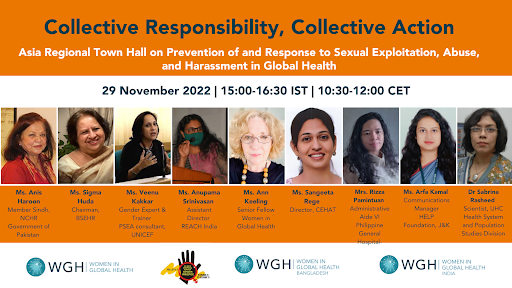
On day 5 of the 2022 Prajnya 16 Days Campaign Against Gender Violence, Women in Global Health hosted its third regional town hall on the Prevention of Sexual Exploitation, Assault, and Harassment (PSEAH), which focused on the Asian region, in collaboration with the Prajnya Trust. 


The event brought together representatives from CSOs, governments, international organisations, and activists to continue the conversation on the need to develop regional collaborative mechanisms and reaffirm our commitment to eliminate SEAH. 

The keynote remarks were delivered by Dr. Poonam Khetrapal Singh, Regional Director for WHO South East Asia; and Ms. Anis Haroon, the Sindh representative of the National Commission of Human Rights, Pakistan. The event was moderated by Ms. Anupama Srinivasan, Assistant Director at REACH, India. 

Other speakers and panelists included:

  • Ann Keeling, Senior Fellow, Women in Global Health

  • Dr Sabrina Rasheed, Scientist, ICCDR,B; and lead for the Bangladesh chapter of Women in Global Health

  • Ms. Veenu Kakkar, Gender Expert & Trainer; PSEA consultant with UNICEF

  • Mrs. Rizza Pamintuan, PGH Women’s Desk

  • Sigma Huda, President of Bangladesh Women Lawyers Association (BNWLA); Founder & Secretary of Institute for Law and Development (ILD)

  • Arfa Kamal, HELP Foundation Kashmir

  • Ms. Sangeeta Rege, Director, CEHAT (Centre for Enquiry into Health and Allied Themes) 


Watch the video of the event here

Friday, November 25, 2022

Day 1: The GVR 2022 Launch

We are delighted to launch the 2022 Prajnya Gender Violence in India Report (GVR), on the first day of the 2022 Prajnya 16 Days Campaign Against Gender Violence. For the launch of this year's GVR, we had with us, Kausumi Saha (author-curator of the 2022 GVR) and Dr. Saumya Uma (Professor, Jindal Global Law School). The session was moderated by Dr. S. Shakthi. You can watch a saved copy of the recording here.


Kausumi Saha, works as a Researcher and Project Coordinator at Gender at Work. She has a Master's degree in Sociology from the Delhi School of Economics and is currently working towards a second postgraduate degree in Psychology. Her research interests lie in the intersections of media, youth subcultures, gender, identity formation, and mental health. This is Kausumi's third year working on Prajnya's Gender Violence in India report.


  • "The 2022 Prajnya Gender Violence in India Report takes stock of the state of gender violence in India using definitions, statistics (where available), and highlights of recent cases of gender-based violence that have appeared in the news."
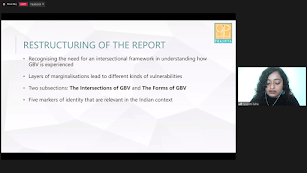
  • "Intersectionality is a framework that recognizes women are not a homogenous category and that they do not experience violence the same way...Keeping that in mind, and in our quest to make the report more intersectional, we have restructured the report very differently this year."
  • "Part I of the Report: The Intersections of Gender-Based Violence presents an overview of five markers of identity that are relevant in the Indian context: caste and indigenous identities; queerness; old age; disability; and the experiences of religious minorities"
  • "Dalit and Adivasi women face violence from the oppressor caste due to their caste/indigenous status and their gender and within their own community due to their gender identity. This is called double marginalisation. Additionally,
  • all kinds of gender-based violence have an element of power attached to them. When we look at violence against Dalit and Adivasi persons, it is a demonstration of power and a weapon to reinforce the existing structural hierarchies."
  • "There is also a large amount of symbolic violence that the queer population faced. This is in the form of non-recognition of their queer identities like the usage of wrong pronouns or deadnaming queer individuals."
  • "There is little to no research on sexual violence against elderly women due to the shame and the stigma associated with it."
  • "Women with disabilities are often financially and socially dependent on others for their survival and the perpetrators of violence are often caregivers, present either at homes or in institutional settings."
  • "We have seen that any kind of large-scale communal violence is almost always accompanied by an aspect of sexual violence."


Dr. Saumya Uma, professor at Jindal Global Law School and the Director, Centre for Women's Rights (JGLS) followed Kausumi's presentation with a talk on the report. Prof. (Dr.) Saumya Uma is a Professor at Jindal Global Law School and heads its Centre for Women’s Rights. She has over 28 years’ combined work experience as an academic, law researcher, lawyer, trainer, writer and campaigner on gender, law and human rights. She has served as a research consultant on human rights, with international agencies such as the United Nations Development Fund (UNDP), United Nations Office of the High Commissioner on Human Rights (UNOHCHR) and the International Commission of Jurists (ICJ). Additionally, she worked as the National Coordinator of ICC-India: the anti-impunity campaign on International Criminal Court and its relevance to India – from 2000 to 2010. Dr. Uma teaches and researches at the intersection of gender, human rights and the law. In particular, she writes on feminist jurisprudence; international criminal justice and its relevance to India; victim and witness protection; justice and accountability for mass crimes; South Asian women’s movements and the feminist envisioning of justice; human rights law and lawyering; gender-based violence and reparative justice; access to justice; social exclusion and marginalization; clinical legal education; and feminist pedagogy.


  • "One of my first observations is on the aspect of Kidnapping and Abduction of Women and Girls...If we look at the 2020 and 2021 statistics, we see a significant increase in the Kidnapping and Abduction of Women and Girls, and in the Kidnapping and Abduction of Women to compel her for Marriage.....Partly, this increase (in reported cases) could be due to the increased incidence of kidnapping and abduction, but there may also be cases of more inter-caste and inter-religious marriages or lesbian couples leaving homes which the parents register under complaints of abduction."
  • "Despite all the propaganda, resistance and the institutional reluctance to register complaints of domestic violence, there is still a sizeable number that is getting registered...In the covid years, when women were trapped in their homes because of lockdowns and working from home, worldwide, domestic violence increased during those years. So, the 2022 statistics are likely to show this kind of increase."
  • "There are forms of cyber-stalking which are not only by strangers but also by partners. I think this is just increasing the violence that takes place. We need to remember that stalking, rape and murder are all quite linked and there are many cases where stalking, when not stopped or prevented, has led to rape and murder."
  • "For women who were working from home, colleagues were contacting them through cyberspaces. There were forms of sexual violence at workplaces that call for the expansion of the definition of workplace to include homes as well."
  • "We need to look at domestic violence, intimate partner violence, patriarchy, misogyny, Indian masculinity, and the everyday violence that women are facing in relationships. I see and hear of these from my students as well. We think that the younger generation is very liberated in some sense, but they too are in the same trap of patriarchy and misogyny to a large extent."
  • "It is important to look at the violence inflicted on transgender women, lesbian women, gender non-confirming individuals, gender non-binary individuals...The kind of shame, stigma and institutional apathy against them is so much more, and yet it is undocumented."
  • "There are limitations in the law. The law is slow to catch up and the interpreters of the law are much slower to catch up with what is happening. So, while the law may be a part of the solution, what is really needed is social consciousness and political action."

Prajnya’s Gender Violence in India Report has been taking stock of the state of gender violence in India since 2009. The report is meant to be used as a ready reference for activists, journalists, students, lawyers and anyone with an interest in gender justice. You can access the Prajnya Gender Violence in India Report 2022 here.


Saturday, December 11, 2021

Day 16: Regional Perspectives on Honour, Violence and Women's Rights: A Panel

The final day of the Prajnya 16 Days Campaign Against Gender Violence was on Regional Perspectives on Honour, Violence and Women's Rights: A Panel Discussion. We closed with a panel that depicted how violence in the name of 'honour' transgresses borders. Here, pride takes the front seat, thereby justifying gruesome killings, often with the support of the state's machinery. 

Our facilitator of the session, Kiran Moghe, opened with how "the question of women's honour is tied up with the community and she represents the community/ collective honour, which has a bearing on her everyday life; she is subject to several kinds of restrictions on her basic freedom and on her basic right to life. These are very fundamental questions related to our existence as women."

Our first speaker, Jagmati Sangwan addressed the manner in which the state and its units have failed to address the brutality that is honour crimes, with a focus on the ground realities in Haryana. 

  • "Usually common people around us take honour killings and honour crime as due to generational gap of ideas, parents losing control over their sons and daughters-in-law But our experience is that there has been a whole political economy attached to this issue. The political economy is to maintain the hierarchical social structures and cultural norms in the society. The control of female sexuality is crucial in patriarchal setups and hegemonic societies. If the women exert their choice in the issue of marriage, there is a seed of formation of an egalitarian society coming into existence as a result of these marriages. This concern, we feel, has been given the name of honour to control the sexuality of women. This is the crux of this issue."
  • "The major distortions made here to punish these couples is by tampering the birth certificate and showing the couple as underage, and registering cases of kidnap and rape against boys. The human rights protection agencies have delayed and ineffective responses. The judiciary here doesn't take suo moto cognisance of such cases. Most social organisations and NGOs avoid speaking on such issues because they fear and targetting."
  • "The nature of this violence, like dowry, is where one's own people get involved in crime and killing, maybe under huge social pressure. So, nobody comes out to register the case. The judicial system needs witnesses and proof of the crime. The onus has to be shifted on the criminal.

Watch Jagmati Sangwan's video here. 

Vincent Kathir, from Evidence, was our second speaker. He highlighted, through heart-wrenching anecdotes how the state, at various levels have failed to accurately report these crimes.

  • "From my experience, honour crimes are the product of structural patriarchy, male chauvinism as well as caste."
  • "In an RTI filed for the number of honour-related crimes show fifty-five cases of honour killings, but the Tamil Nadu government says there are only four cases in the last five years. Since 2005, when we started working on honour killings-related cases, [we have seen that] honour killings happen across the state and 60% of the time on women."
  • "We tried to challenge every honour killings legally but we have succeeded in a few cases...We cannot expect the government to show interest that the families would. In some cases, families are hostile, and in some cases, they come to a compromise."
  • "In my opinion, in the field, I have worked in human rights since 1995, and since 2000, I began working with honour-related crimes - this is a terrible and brutal form of murder. A few years back, the Supreme Court said that states should file an affidavit. Only twenty-two states accepted [that there is a presence of honour killings in the state], but till now the Tamil Nadu Government has not accepted that there are honour killings here. This is a dangerous situation.
  • "In 2019, Madras High Court, in suo moto regarded our Evidence report on honour killings and then ordered the government to respond. Immediately, the state government responded in front of the High Court that all districts will have a protection cell formed for inter-caste couples. I verified this a month ago. Out of 38 districts, only 3 districts have formed the cell. The other 35 districts have not formed the protection cell."

Watch Vincent Kathir's presentation here.

The third speaker, Benazir Jatoi, highlighted the perspectives from Pakistan showing the commonality of this issue across borders.

  • "You talk of caste, caste is the excuse used. We may not have an obvious caste system, but we use other words. We use religion. We use gairat, which roughly translates to honour. It is the socio-economic guise that we give on how we control women through violence and discrimination."
  • "The irony in the whole situation is that we keep fixing the law till the situation is perfect. Every time a case of honour crime catches the public eye, the lawmakers perfect the law so that the loopholes identified by activists are closed. 
  • What the laws failed to recognise, and laws are limited, the trial judge doesn't have that capacity, with all due respect, to separate honour from murder."
  • "When we use the word honour, we, as activists have no other language. We use the language of our community. If we use honour before killing, we have already given them [the society] one justification to get away with it. Honour is a justification...so dishonour is perhaps the language we should walk towards. Because, we must take away that justification that is the stranglehold of all this."
  • "In Pakistan, the Penal Code is intertwined with the Islamic law....we allow [for the existence of] certain Islamic laws which are forgiveness and compromise....Forgiveness is a very big part of religion. What they don't take into account is that forgiveness before the crime is also a very big part of religion. But, here once a crime is committed, forgiveness is invoked."
  • "While we talk about violence against women and honour crimes, in particular, what we need to address is what is the relationship of women with the state. I feel, if there is a relationship with the state that women have, it is indirect. Women don't have a direct relationship with the state. If that relationship exists, it is weak, and that relationship is breaking down. When there is a weak and indirect relationship, things like COVID-19 has highlighted that anyone already discriminated against will be discriminated against further. Anyone prone to violence will be much more prone to violence."
  • "We don't talk about sexuality [like the first speaker highlighted] enough but it comes down to that. Why do we fear sexuality so much? Why does patriarchy make us fear sexuality.? It starts from the control of sexuality. It is a box that we belong in. But, they tell us that we should exercise our sexuality because we should give birth, and give birth to many children.....but that sexuality is feared when we exercise it. It is different when someone else controls it. Sexuality needs to be viewed from the point of view of the global south."

Watch Benazir Jatoi's presentation here.

Our final speaker was Shalini Umachandran who highlighted the importance of sensitive reporting in cases of gender-based violence, especially honour crimes.

  • "Very often, how the survivors or victims were affected as human beings are erased from the reports. We need to hear about how drastically their lives change and how shocking it is."
  • "What we call honour killings is not just limited to patriarchy, gender, caste but also about personal choice. It is about a society that doesn't respect personal economic and political freedom. We need to widen our understanding and reporting so that all of this comes into it."
  • "It is not just inter-religious or inter-caste. In India, it is about any two people from the same subgroup that isn't approved, and so they send clans."
  • "It is this refusal to accept and understand the need for personal freedom which we see at a personal and family level; it is spread much wider. We see it in government policies, in the toxic bigotry we see in our daily life and on social media. It is not just a family issue."
  • "Most underreporting is by the state and not the media or Civil Society Organisations. Journalists do cover these in detail and CSOs do a lot of reporting. In the last few years, it has become more detailed, careful and in most cases, a lot more sensitive. But we need to be mindful of how we speak, behave and the language we use in newsrooms when we speak with friends and our attitudes so that people can make their own decisions and don't have to follow archaic rules."
  • Some of the Dos given by her were "If you're interviewing a survivor, make them comfortable. Get their consent before quoting them. You will go by their decisions on how much detail you will go into. It is possible to have a perfectly accurate report without being intrusive and causing more trauma to someone. Keep your tone empathetic and neutral. Keep the organisation that helped you get in touch with survivors about the progress of the story." while a couple of critical points to take note of are "Don't make promises because you know you can't keep them...Don't share contact details without permission."

Friday, December 10, 2021

Day 13: Reporting Gender Violence Against Persons With Disabilities: Media Training

On the 13th day of the Prajnya 16 Days Campaign Against Gender Violence, The Network of Women in Media in India, Shanta Memorial Rehabilitation Centre, and Prajnya invited Dr. Aishwarya Rao to conduct a short training on how to report gender-based violence against people with disabilities, including themes of what is the appropriate language; what questions should be asked, and which ones avoided; and legal frameworks. Here are a few key discussion points from the session:

  • "Over the years we have seen reporting on violence, particularly in the context of women with disabilities has improved. Almost every year, once in every ten days at least, a mainstream newspaper or news channel talks to either me or my colleague in the disability sector, or the other women with disabilities I work with. And definitely, the reporters come with a good amount of sensitization. And so, the stories that are reported definitely show more focus, better language - there is definitely a significant improvement. But more work needs to be done."

  • "Though the scale of violence for persons with disabilities is high, especially for women with disabilities or persons who identify as women, coverage has seldom been adequate when you compare the extent of the problem."

  • "There is no big violence and small violence. Every violence, every infringement of a right, every harm, every suffering that anybody goes through on account of simply being of a gender that is different from the dominant gender or the gender that has the upper hand - all these are worth reporting. But somehow we see sexual violence gets more eyeballs."
  • "When journalists write or report instances of violence perpetrated on young women, other women, the minorities, sexual minorities or children with disabilities, here are some pointers that are important for us to keep in mind when such reports or stories are made:

1. To be accurate and use the right language

2. To get the survivor's voice out and to not victim blame

3. Talk to experts

4. Educate the public

5. Include information where survivors and families can get assistance"

  • "Victims or survivors of violence, or persons upon whom violence ha been inflicted are many times portrayed as objects of pity. And, there is a great deal of stereotyping that happens. And, whether we like it or not, there is a great deal of disability voyeurism that happens."

  • "Popular narrative, at least in regional languages when discussing disability and talking disability has always been cringe. Sometimes I wonder whether the language itself is inadequate in explaining the disability and in explaining the life of a person with a disability. 


  • "There are some questions that are worth remembering to ask - 

How can I raise awareness?

Is the portrayal consistent with the respect for the person?

Name the disability and the vulnerability?

Link the issue to a larger overarching issue or a broad theme on the basis of which policy initiatives can be better informed."

  • "When there is a confusion, use the word disability and it is okay, rather than impairment, special needs, deficit, because then we are going to the definition of disability. Disability is not defined as a characteristic of that person. So we don't look at locomotive disability as an impairment of that person. Disability itself is defined as an interaction between the person and the environment...Disability is about how a person with a disability interacts with the environment...Instead of using wheelchair-bound, use wheelchair user. Disabled is the most preferred by activists. Persons with a disability or PwD is always safe....the appropriate words to use are a person with a developmental disability, a person with an intellectual disability, intellectually/developmentally disabled, a person with mental health issues, or a person with so-and-so diagnosis. Don't use a person with autism, use autistic or neurodivergent. Don't use patient. Instead, refer to them by their name- so-and-so who has this particular condition. Always refer to the person with the name. Don't use mute, high-functioning, low-functioning - it is best to leave out the description of functioning. 'Special needs' is not okay, instead talk about reasonable accommodation or modifications. Never use sufferer, afflicted, stricken."
Dr. Rao has generously made her presentation available to us for reference. You can access it on Slideshare.

Tuesday, December 7, 2021

Day 12: Twitter Takeover by Nadika Nadja

 Originally scheduled on the 10th Day of the 16th Day Campaign Against Gender Violence by Prajnya, today, we had Nadika Nadja organize a Twitter Spaces on "Critiquing Exclusionary Feminism, Re-imagining Solidarity". A few of the discussion points are outlined below:


  • A significant part of the discussion looked into this new idea of trans-exclusionary radical feminism (TERF) which is now resurfacing as 'gender-critical feminism' that only considers "biologically female women and men" as men and women thereby making feminist spaces exclusionary. We also had Ragamalika who mentioned how this one BBC article portrayed transwomen as assaulters of ciswomen and that they are basically men. The article also said that giving rights to transwomen takes rights away from ciswomen. Nadika responded to that saying there are a number of movements in the US and UK, and in parts of India about gender-critical feminism, which is replacing the term 'TERFS'. It gives the impression that transwomen are not women. Spaces must exist only for 'biologically female women'. There are a lot of people behind GC, especially British media because there are people like JK Rowling, for instance. You expect certain influential people to have a nuanced understanding and not be GCs. The article by BBC also quoted a survey that said transwomen forced cislesbians to have sex with them, however, the survey only consisted of GC folks. 
  • This brings about a certain kind of dissonance in how we view solidarity, even in spaces that are queer-friendly and among ciswomen who are queer. The whole idea of the trans movement and the trans rights movement is that self-determination is the most important thing. People also say that we have to respect women and not reduce them to walking talking vaginas and wombs but at the same time reduce them to walking talking vaginas and wombs but at the same time in terms of trans people.
  • Dr. S.Shakthi asked why there was a sudden uptake in the number of GC-related information. Nadika responded that there is a growing number of right-wing movements across the world. Like Judith Butler had mentioned, there exists a correlation between fascist ideas and authoritarian GC regimes.
  • A lot of conversations by GCs and people who are somewhere there [can be categorised as GC], is that they believe one isn't a woman because they haven't had their periods. Raga spoke about how there is a reduction in the experience of womanhood and gender to just that one thing (periods). It seems to be a very convenient topic of discussion. That, if you haven't had your periods, you don't know what "we" go through. These statements also don't acknowledge that people assigned female at birth have different experiences. But, these experiences are all clubbed together based on whether an individual gets their periods and how painful it is. 
  • One important thing is to look at where these exclusionary conversations start from. The easiest thing is to blame European colonialism where there is a cataloging and classification of everything. This leads to forming categories that are simple, wide-open but also, restrictive. That is where this idea of the biologically essentialist view comes from (on what defines one as a man and woman). Nadika sees colonialism and the early capitalist industrial revolution to be something that led to this exclusionary space. Because these periods are also tied to the idea of productivity - producing a child is important in a capitalist colonial society. Only one who can engage in productive and reproductive work is a woman, thereby excluding transwomen from the idea of woman and transmen from the idea of manhood.
  • The idea of intersectional feminism (looking at factors like ethnicity, race, ableism, etc) is that they critique a certain kind of feminism practiced by white women who just want political rights. The exclusion comes from the perspective of who or what can be 'feminine' enough and whoever falls outside of these labels will not be included in the feminist movement. These ideas also exclude people who think they fall inside the boundaries because they don't adhere to the 'norms' prescribed by TERFs and GCs. 
  • We also had listeners chip in about how there is a fear of loss of power and it is critical to address and tackle it by talking about the importance of accessibility to rights. Additionally, you also have the feminism portrayed by the popular culture where privileged people (or, even, cis people acting as trans folks on-screen) which is worshiped. 
  • The discussion also spoke about how sports views trans folks, about the debate around college hostels being gender-neutral and on toilets being gender-neutral.
  • We talk about building solidarity, but with all these differences, where do you see solidarity coming from? What are the things we can do to build solidarity? Where do we start building this idea of solidarity from?
  • The listeners responded that there are quite a few ways, they believe, helps strengthen solidarity, and reimagine movements - passing the mic and giving space to people who are marginalized, being open to unlearning and taking responsibility as well as understanding that it is essential to have uncomfortable conversations with people who have similar privileges as you. Empathy and kindness are also very important here.
  • Nadika and Raga also highlighted that when we talk of marginalised folks joining various spaces to talk about their experiences, there is a lot of labour that is put in to explain where a person is coming from. There is enough knowledge and information on the internet to understand this. Additionally, there is also a perceived power difference in the space someone else is organising. 
  • We also had with us Nidhi who spoke about how it is necessary to understand the ways in which ableism affects persons with disabilities. It is important to see if we can think about bodies and minds that work differently, but also that it is not something we can accommodate just by being nice. One must actively see it structurally rather than just as something each of us can do to make it okay.
  • The concluding remarks were that a lot of feminists, feminist organizations and institutions grapple with understanding intersectionality and queer issues. Grassroots feminist organizations must actively take steps to ensure their actions are inclusive. We have made it a fight of power rather than a fight of rights, and a fight for equality. It almost seems like there is a queue to fight for your rights. The fight isn't a token system. People must step out of their own bubbles, and not just focus on their own struggles and have to start listening.