Showing posts with label Kausumi Saha. Show all posts

Friday, November 25, 2022

Day 1: The GVR 2022 Launch

We are delighted to launch the 2022 Prajnya Gender Violence in India Report (GVR), on the first day of the 2022 Prajnya 16 Days Campaign Against Gender Violence. For the launch of this year's GVR, we had with us, Kausumi Saha (author-curator of the 2022 GVR) and Dr. Saumya Uma (Professor, Jindal Global Law School). The session was moderated by Dr. S. Shakthi. You can watch a saved copy of the recording here.


Kausumi Saha, works as a Researcher and Project Coordinator at Gender at Work. She has a Master's degree in Sociology from the Delhi School of Economics and is currently working towards a second postgraduate degree in Psychology. Her research interests lie in the intersections of media, youth subcultures, gender, identity formation, and mental health. This is Kausumi's third year working on Prajnya's Gender Violence in India report.

  • "The 2022 Prajnya Gender Violence in India Report takes stock of the state of gender violence in India using definitions, statistics (where available), and highlights of recent cases of gender-based violence that have appeared in the news."
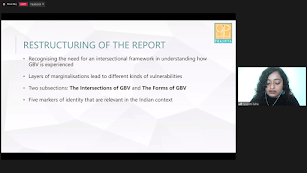
  • "Intersectionality is a framework that recognizes women are not a homogenous category and that they do not experience violence the same way...Keeping that in mind, and in our quest to make the report more intersectional, we have restructured the report very differently this year."
  • "Part I of the Report: The Intersections of Gender-Based Violence presents an overview of five markers of identity that are relevant in the Indian context: caste and indigenous identities; queerness; old age; disability; and the experiences of religious minorities"
  • "Dalit and Adivasi women face violence from the oppressor caste due to their caste/indigenous status and their gender and within their own community due to their gender identity. This is called double marginalisation. Additionally,
  • all kinds of gender-based violence have an element of power attached to them. When we look at violence against Dalit and Adivasi persons, it is a demonstration of power and a weapon to reinforce the existing structural hierarchies."
  • "There is also a large amount of symbolic violence that the queer population faced. This is in the form of non-recognition of their queer identities like the usage of wrong pronouns or deadnaming queer individuals."
  • "There is little to no research on sexual violence against elderly women due to the shame and the stigma associated with it."
  • "Women with disabilities are often financially and socially dependent on others for their survival and the perpetrators of violence are often caregivers, present either at homes or in institutional settings."
  • "We have seen that any kind of large-scale communal violence is almost always accompanied by an aspect of sexual violence."


Dr. Saumya Uma, professor at Jindal Global Law School and the Director, Centre for Women's Rights (JGLS) followed Kausumi's presentation with a talk on the report. Prof. (Dr.) Saumya Uma is a Professor at Jindal Global Law School and heads its Centre for Women’s Rights. She has over 28 years’ combined work experience as an academic, law researcher, lawyer, trainer, writer and campaigner on gender, law and human rights. She has served as a research consultant on human rights, with international agencies such as the United Nations Development Fund (UNDP), United Nations Office of the High Commissioner on Human Rights (UNOHCHR) and the International Commission of Jurists (ICJ). Additionally, she worked as the National Coordinator of ICC-India: the anti-impunity campaign on International Criminal Court and its relevance to India – from 2000 to 2010. Dr. Uma teaches and researches at the intersection of gender, human rights and the law. In particular, she writes on feminist jurisprudence; international criminal justice and its relevance to India; victim and witness protection; justice and accountability for mass crimes; South Asian women’s movements and the feminist envisioning of justice; human rights law and lawyering; gender-based violence and reparative justice; access to justice; social exclusion and marginalization; clinical legal education; and feminist pedagogy.


  • "One of my first observations is on the aspect of Kidnapping and Abduction of Women and Girls...If we look at the 2020 and 2021 statistics, we see a significant increase in the Kidnapping and Abduction of Women and Girls, and in the Kidnapping and Abduction of Women to compel her for Marriage.....Partly, this increase (in reported cases) could be due to the increased incidence of kidnapping and abduction, but there may also be cases of more inter-caste and inter-religious marriages or lesbian couples leaving homes which the parents register under complaints of abduction."
  • "Despite all the propaganda, resistance and the institutional reluctance to register complaints of domestic violence, there is still a sizeable number that is getting registered...In the covid years, when women were trapped in their homes because of lockdowns and working from home, worldwide, domestic violence increased during those years. So, the 2022 statistics are likely to show this kind of increase."
  • "There are forms of cyber-stalking which are not only by strangers but also by partners. I think this is just increasing the violence that takes place. We need to remember that stalking, rape and murder are all quite linked and there are many cases where stalking, when not stopped or prevented, has led to rape and murder."
  • "For women who were working from home, colleagues were contacting them through cyberspaces. There were forms of sexual violence at workplaces that call for the expansion of the definition of workplace to include homes as well."
  • "We need to look at domestic violence, intimate partner violence, patriarchy, misogyny, Indian masculinity, and the everyday violence that women are facing in relationships. I see and hear of these from my students as well. We think that the younger generation is very liberated in some sense, but they too are in the same trap of patriarchy and misogyny to a large extent."
  • "It is important to look at the violence inflicted on transgender women, lesbian women, gender non-confirming individuals, gender non-binary individuals...The kind of shame, stigma and institutional apathy against them is so much more, and yet it is undocumented."
  • "There are limitations in the law. The law is slow to catch up and the interpreters of the law are much slower to catch up with what is happening. So, while the law may be a part of the solution, what is really needed is social consciousness and political action."

Prajnya’s Gender Violence in India Report has been taking stock of the state of gender violence in India since 2009. The report is meant to be used as a ready reference for activists, journalists, students, lawyers and anyone with an interest in gender justice. You can access the Prajnya Gender Violence in India Report 2022 here.


Friday, November 26, 2021

Day 1: The GVR 2021 Launch

It is a delight to launch the 2021 Prajnya Gender Violence in India report, on the first day of the 2021 16 Days Campaign Against Gender Violence. The report hopes to articulate the many ways in which gender violence manifests in our society, the laws that address specific types of violence, and a compilation of cases and statistics. 

As rightly said by Dr. S. Shakthi, who moderated the session, "each iteration of the report [since 2009] has built on those that came before it, and the 2021 report carries with it, in some sense, the history of Prajnya itself." We are also glad to mention that the 2021 report, by our author-curator (for the second time in a row!) Kausumi Saha, includes a new chapter on 'Gender-Based Violence against Dalit and Adivasi Communities'.

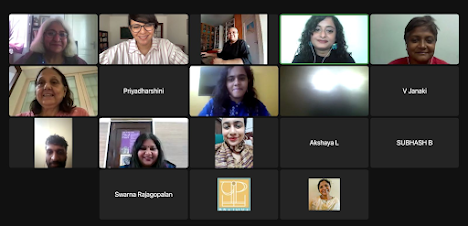
an image of the speakers, attendees and organisers taken on Zoom [a video conferencing application].

Along with Kausumi, we also had with us, as our special guest and commentator. Dr. Rukmini Sen, Dr. B. R. Ambedkar University, Delhi, who was kind enough to offer her valuable insights on the report. You can watch a saved copy of the recording here.


An image of Kausumi Saha, author-curator of the GRV 2021.
Kausumi Saha opened the session with her experience on curating the report, and on the importance of adopting an intersectional lens while looking into gender-based violence.

  • "Recently, the draft population policy in Uttar Pradesh, [a policy] which is highly punitive in nature, bars people who have more than two children from applying to government jobs and getting government subsidies. This has been criticized widely because it will, for sure, lead to higher instances of female foeticide and unsafe abortion, but also, it targets certain communities and takes away agency and control from women over their own bodies and reproductive lives."
  • "The Government of India has recently created a task force which recommends an increase in legal age of marriage of girls to 21 which faces criticisms from feminists and CSOs. This is because having the legal age of marriage as 18 has not stopped child, early, and forced marriages from happening. This is unless there is a complete overhaul of structural change in how we see girls and marriage."
  • "Human trafficking has been steadily on the rise during COVID-19 and lockdown, due to increased vulnerability and migration which has not been trackable. To add is the issue of slowing down of rescue units as anti-women trafficking movements have not been functioning during lockdown and pandemic."
  • "Workplace sexual harassment in the pandemic has found new places and more and more ways of expressing itself. There are instances of cyber-based violence in online classrooms and online workplaces, using emails and social media...During the second wave, when hospital beds and oxygen support was not available, and more and more women had to share their contact details online, their numbers were circulated widely without their consent and they have faced various kinds of harassment like - unwanted phone calls, images, and messages."
  • "Over the last few years, due to changes in increased fundamentalist forces in India, we have had a new wave of so-called 'love jihad cases and crimes related to that which is another form honor-related crimes, having its roots in both casteism and patriarchy, but also in islamophobia."
  • "We keep in mind that gender violence cannot be read independently of the intersecting identities of caste, tribes, economic class, abilities, sexual orientation, and so on. Power dynamics really lie at the center of gender-based violence. The various kinds of marginalizations that Dalit and Adivasi women face because of their social, cultural, and economic identities means that they are much more vulnerable to sexual and gender-based violence."
  • "What puzzles me is the language that continues to be used in the legal system- a language which is highly patriarchal, highly infantilizing towards women, and of course, there is barely any mention of gender minorities and queer persons...it is while writing this report that I actively look over cases and data, and I am continually shocked and surprised that we still have this kind of a language. We still look at women primarily as victims and our rape laws and our sexual assault laws are still very gender-blind. The pandemic has been such an eye-opener; We knew gender violence existed but the pandemic really brought into light the nuances and the various ways in which gender violence manifests." 

Prof. Rukmini Sen, during her comments on the report, shared with us the different theories that have shaped feminist spaces, and that it is imperative for us to (re)imagine feminist politics. She also highlighted that violence against persons with disabilities, and transgender persons continue to remain invisible in conversations centering around gender-based violence, and it is critical to create spaces for such dialogues.

  • "Remembering state impunity of any form of resistance and especially being threatened by any form of resilient solidarity, I would like us to salute the fighting spirits of all women and people of multiple genders encountering, negotiating, and surviving violence in their homes, workplaces, streets or caught in the crossfires of conflicts. It is equally important to foreground the importance of care and support that is needed as we engage with violence."
  • "There are 16 categories of gender-based violence that are discussed in the report following a consistent pattern that it takes - 
    • 1) What is the nature of the violence in question
    • 2) The manner in which international human rights conventions and protocols define this violence
    • 3) The data available on the violence from government sources, international agencies, and Indian human rights finding reports
    • 4) The mention of existing laws in the Indian Penal Code that seeks to address this specific gender-based violence in question
    • 5) The recent newspaper-based reporting or NGO-based reporting on that specific violence
    • 6) The ways of accessing the criminal justice system when a specific incident of gender-based violence happens
    • 7) A brief discussion on decisions coming in judicial pronouncements around violence when it reaches the court."
  • "While doing a course on Violence: Feminist Resistance and Critiques with the Gender Studies students in 2018 at Ambedkar University, Delhi, [we discussed] the ordinariness of violence; not the event-driven ones but the everyday ones; not the ones which only make national headlines, but also the ones that are projected as politicized or political; invariably the instances where the intersectionalities of the violence are evident - a case in point, Hathras, and Unnao. An exercise on 'walking the city' was conducted where a group of people, identifying themselves through multiple genders, in the evening, in an area which is historically significant in Delhi. Yet, this site is not explored for feminist classrooms.....walking is to knowing, and knowing is the first step towards overcoming fear of public spaces, which is a step towards developing feminist consciousness. In this assignment, a student reflected, and I quote - this took the form of an experiential walk because it not only assured us that public spaces are in reality supposed to be public, but each one of us who shared the experience now holds the narrative that affirms faith in solidarity."
  • "The inclusion of emotional abuse under the right to live with dignity is definitely a significant move and it brings me to argue that it is necessary to talk care, support, friendship together with discussing violence. In my EPW Essay Stay Home, Stay Safe: Interrogating Violence in the Domestic Sphere (2020), I suggest that we need to push the contours of discussion to reconceptualize both home as well as domesticity. We need to initiate talking about various kinds of shared residences, not only the ones that are formed through heterosexual homogamous marriages but foreground the political importance of affordable, abuse-free community housing for women, cutting across private-public discourses of violence as well as domestic violence."
  • "Care in its affective sense, in the sense in which it will create solidarity is silenced. One can not imagine the law to do it, but one can, of course, imagine feminist spaces to talk about it. I propose that it is needed to articulate that ethics of care, taking into account the exploits of care economy but also propagating a feminist politics of interdependence and care, alongside articulating multiple expressions of violence for a sustainable and just future."
Read the full-text of Dr. Sen's talk here.

You can access the Gender Violence in India report 2021 here

The programme video is also available on our YouTube channel here.


Thursday, November 25, 2021

2021 Prajnya Gender Violence in India Report


On November 25, 2021, International Day for the Elimination of All Forms of Violence against Women, we are pleased to share with you our 2021 Prajnya Gender Violence in India Report. The 2021 GVR (as we refer to it) was curated and authored once more by Kausumi Saha, working closely with Dr. S. Shakthi at the Prajnya end.

That the report has grown from its original 10-15 pages to almost a hundred is thanks to the hard work of successive authors who have added depth and breadth to watch each chapter covers, and also to our own ongoing efforts to make this truly intersectional. 

You can read the 2021 GVR here: https://prajnya.in/storage/app/media/gvr21.pdf