The 2022 Campaign Report is online! Take a look at the pdf version of the report here.
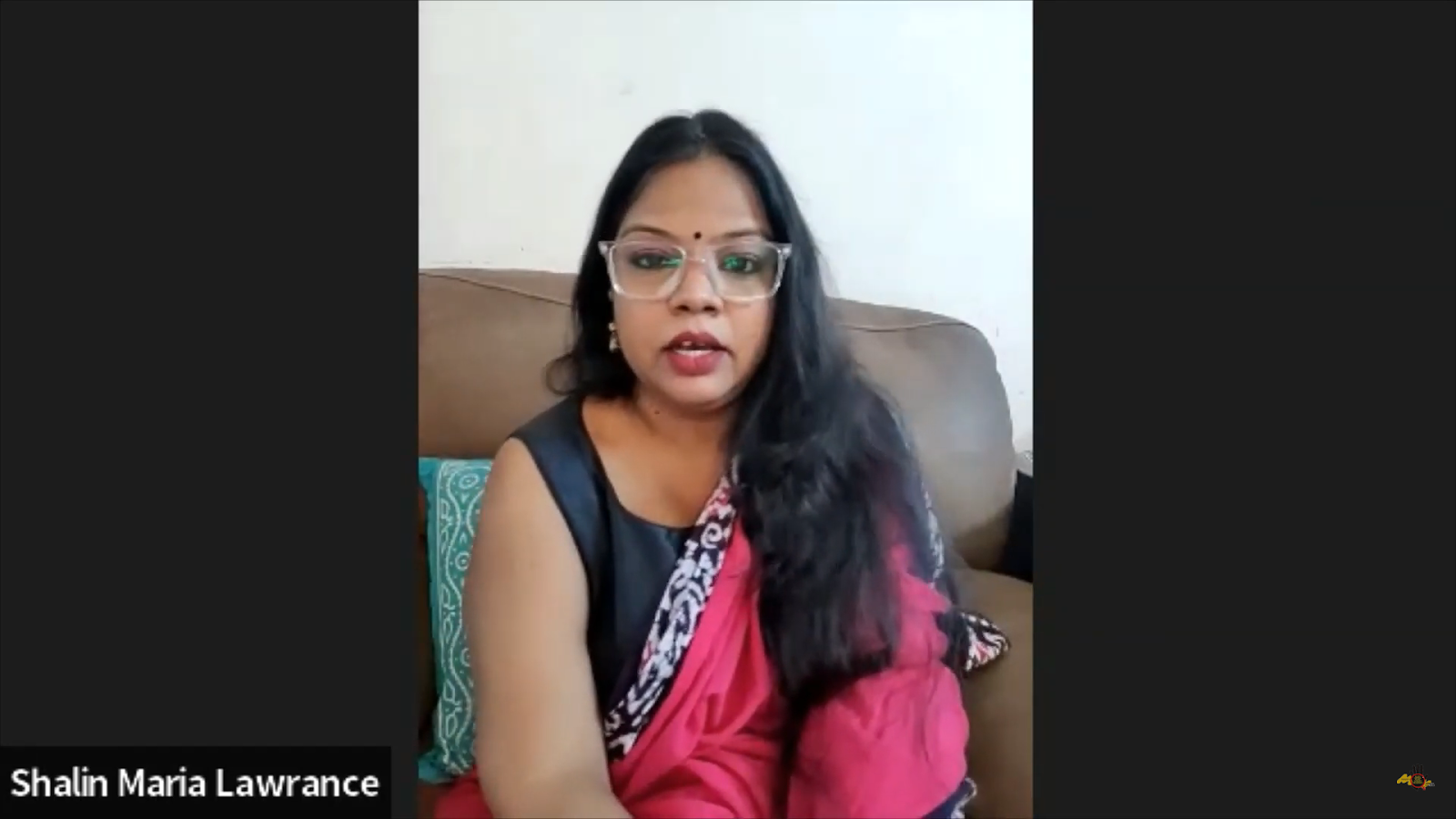
On December 9, 2022, 15th day of the 2022 Prajnya 16 Days Campaign Against Gender Violence hosted an online roundtable discussion on the draft bill on 'Prevention of Crimes in the Name of Honour' that is being shared by Vincent Raj K. for debate in the Tamil Nadu Assembly. Seeing this as a national issue, a panel of discussants from around India was invited. Shalin Maria Lawrence facilitated the session. You may find a saved copy of the recording here.
Kathir Vincent Raj, Evidence:
Shalin Maria Lawrence (Moderator): Shalin Maria Lawrence is a social activist, Intersectional feminist, writer and orator. Belong to the oppressed community, she has been working towards empowering the Dalit Women and LGBTQ+ since 2012. She has worked with the Transgenders Rights Organization and has won the "Day of compassion" award from the Jane Goodall foundation. She has been working with the Dalit communities of the north Madras region, especially in and around Vyasarpadi where I has helped in the setting up of libraries, conducting campaigns and awareness programs towards Education and child rights from 2015. She has also been working with the Dalit women and children in the Dharavi Region of Mumbai since 2016. She has set up a library and has been conducting awareness workshops on women's rights and leadership and the annihilation of caste. For the last two years, she has been conducting regular workshops and training on violence on women, women rights and women leadership among the rural dalit women in and around Madurai and Chennai. She is a writer in English and Tamil and currently publishes her articles in popular magazines and news websites.
Kathir Vincent Raj (Presenter): Kathir Vincent Raj has been working in the field of human rights for over 25 years. A Dalit himself, his witnessing and experiencing caste based discrimination from his childhood triggered his determination to fight against the caste system and caste based atrocities against Dalits. From an initial career as a writer on the experiences of the socially marginalized, he later shifted to rights based interventions, especially human rights monitoring and legal and advocacy interventions. This work experience and a commitment to Dalit rights eventually led him to initiate an independent organization, Evidence in 2005 to fight against caste discrimination and for social justice and equality.
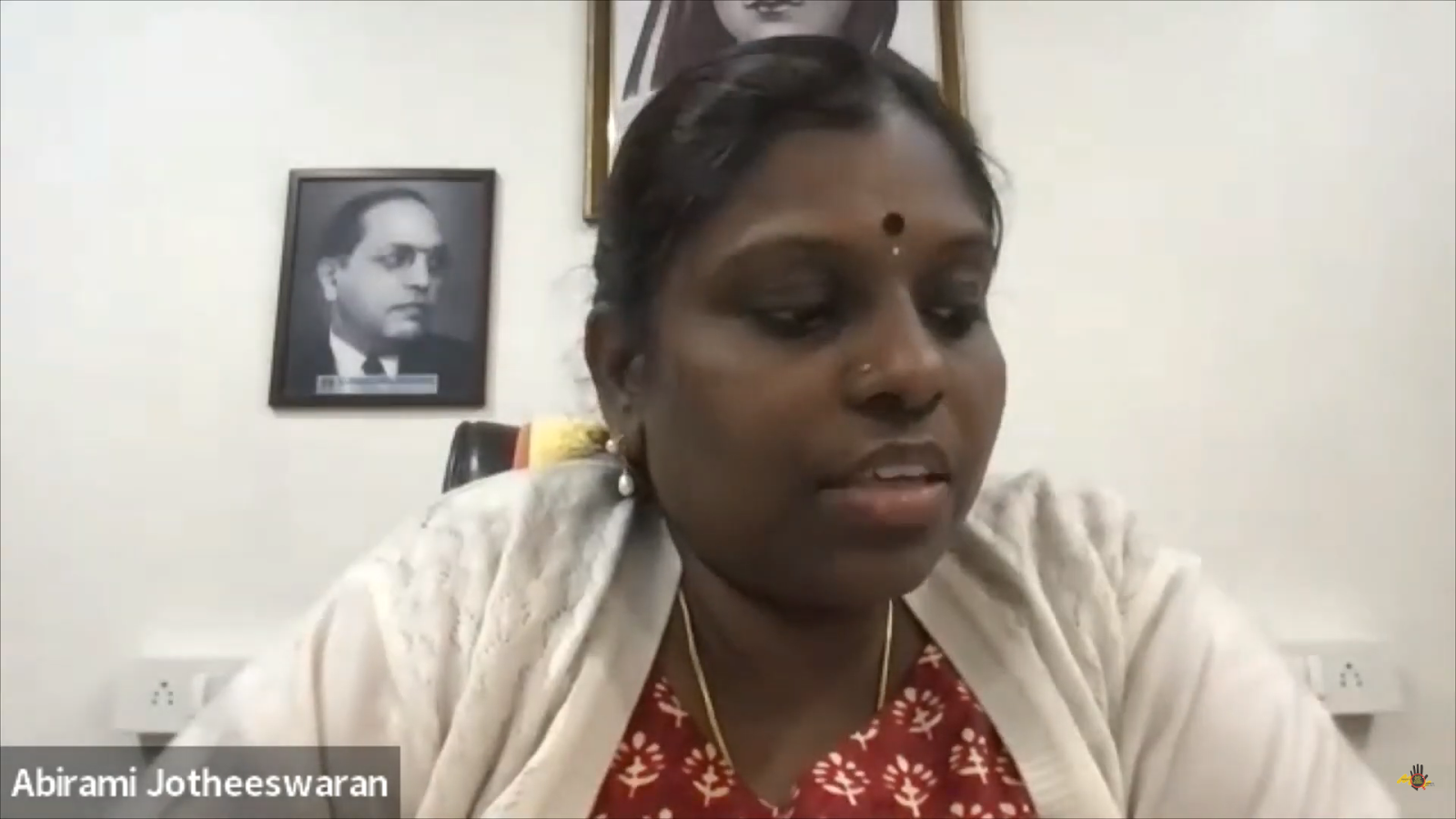
Ms. Abirami Jotheeswaran (Discussant) has been associated with National Campaign on Dalit Human Rights-NCDHR, New Delhi, India since December 2005. Presently Ms. Abirami Jotheeswaran has been serving as the General Secretary of All India Dalit Mahila Adhikar Manch-NCDHR, New Delhi. She herself hails from Dalit Community, very actively involved and committed towards the empowerment of Dalit community. Abirami is a post graduated in Computer Science from University of Madras. Currently, she is pursuing her final year Law degree. Placing her in the organization, her primary responsibilities is to Plan, Monitor and Execute Programs related to Promotion of Dalit Women Leadership and Addressing Violence against Dalit women and minor girls in 7 States across the country. At the international level Abirami Jotheeswaran participated in World Social Forum 2007 held at Nairobi, Kenya and South Africa in 2007, to raise the Dalit concern in the forums. She raised her concern on the Police atrocities committed against Dalits and Dalit Women in 18th EU-NGO Human Rights Forum 2016, Brussels. Abirami Jotheeswaran, actively raised the issues related to Violence against Dalit women and the impunity subsists in India in the 41st UN HR Council at Geneva in the month of July 2019. Under her leadership, AIDMAM recently published a Status Report 2021 - “Dalit Women Rise for Justice” with the confidence that the report will be useful to the government while taking steps to improve Dalit Women’s condition in India through effective implementation of the existing Acts and policies.
V Suresh (Discussant): V. Suresh is a lawyer, Madras High Court; National General Secretary, People's Union for Civil Liberties (PUCL) one of Indias' oldest and largest national level human rights organisation. Earlier served as Supreme Court appointed Adviser on Food Security for Tamil Nadu. Worked for 7 years as a full time activist with the Kashtakari Sanghatana (in Maharashtra) amongst Warli Adivasi marginal farmers and agricultural labourers. Recently appeared in Kannagi - Murugesan Honour Killing case for murdered Dalit Murugesan's family before the Madras High Court. On June 6th, 2022, the Madras HC confirmed the conviction of Kannagi's father, brother and other relatives belonging to Caste Hindu community invovled with the killing, though the HC commuted the death penalty of brother to life sentence.
Dr. Manisha Gupte (Discussant): Dr. Manisha Gupte has been part of the women's movement in India since the mid 1970s; She has also been an activist in the health and civil rights movements. She studied Microbiology (MSc) and then, Sociology. Her PhD thesis was on the concept and practices of patriarchal honour, and how it intersects with caste, sexuality, violence and the agency of subordinated women. She co-founded MASUM, a rural women's organisation in 1987, after living in a drought prone rural area for five years, and has been its co-convenor since then. She spent one year (1997-98) in the Dept. of International Health at the Johns Hopkins University, Baltimore as a visiting fellow. She is actively associated with progressive organisations nationally, regionally and internationally as an advisor, board member or trainer (especially on gender, violence, sexuality, CEDAW and ESC rights). She has participated in, and promoted campaigns related to women's health; reproductive, sexual and minority rights; and, violence against women. She has worked on policy issues with the state and central governments in India over the past three decades. She is the Managing Trustee of Medico Friend Circle (MFC), a 40 year old autonomous health professionals’ group in India, and was the coordinator of the '10th International Women and Health Meeting (IWHM)', held in New Delhi in September 2005. She also coordinated the process towards the preparation of 'The Indian Women’s Health Charter'. She has co-edited a book (2102) titled ‘Honour’ and Women’s Rights: South Asian Perspectives. This book includes 15 papers, highlighting complementary feminist positions from seven countries.
On the 14th day of the 2022 Prajnya 16 Days Campaign Against Gender violence, we organised the "Domestic violence and access to justice: regional perspectives" panel discussion. South Asian states have passed laws on domestic violence but survivors still struggle to access justice. This panel brought together the experiences of Bangladesh, Pakistan, Sri Lanka and India. Watch a saved copy of the recording here.

Panelists: Sara Hossein, Bangladesh Legal Aid and Services Trust; Saba Shaikh, Dastak, Pakistan; Ermiza Tegal, lawyer, Sri Lanka; Shazia Choudhry, Oxford University and Philippa Williams, Queen Mary University of London. The session was facilitated by Suneeta Dhar.
This panel is part of the project Surviving Violence: Everyday resilience and gender justice in rural-urban India funded by the British Academy Heritage Dignity and Violence Programme HDV190009. Research partners: Queen Mary University of London, Chaitanya-The Policy Consultancy, Indian Institute of Technology Bombay, Institute of Development Studies Kolkata, Nari Samata Manch and University of Oxford.

"It almost seems like the COVID pandemic underscored the structural nature of gender inequalities within and across countries, and it essentially brought to light the invisible, unrecognised pandemic of gender-based violence, domestic violence and intimate partner violence. I hate the word shadow-pandemic; I think that domestic violence is not a shadow pandemic. That it was given visibility during this time by the UN and other agencies speaks of how little attention this issue has got over time", Dr. Suneeta Dhar said, as she opened the session.
Shazia Choudhry, Oxford University and Philippa Williams, Queen Mary University of London:



Prepared with notes from Dr. S. Shakthi.
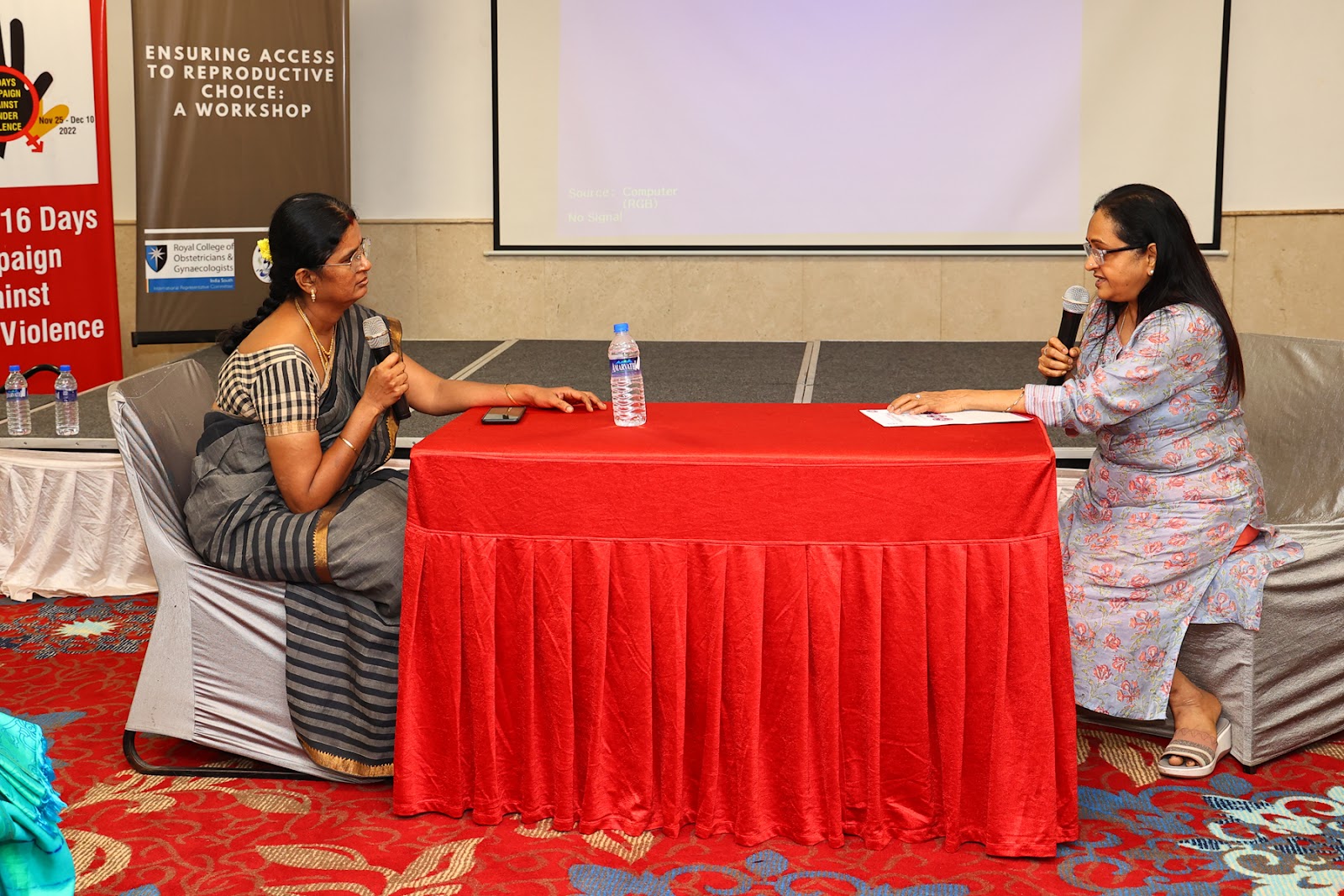
On the 12th day of the 2022 Prajnya 16 Days Campaign Against Gender Violence, we organised an interactive panel discussion, where Dr. Uma Ram, Dr. Prabha Swaminathan, Dr. Jaishree Gajaraj and Archanaa Sekar discussed issues related to sexual and reproductive health rights from the point of view of health care providers. In partnership with ATNRCOG and IRC India South, the 3-hour long event, Ensuring Access to Reproductive Choice: A Workshop" was conducted at Savera Hotel, Chennai.

The topics addressed in
the workshop were Sexual and Reproductive Health and Rights (SRHR), Abortion,
Domestic Violence and Intimate Partner Violence. The discussions aimed at
focussing on how professionals in the medical field would respond to scenarios
on the aforementioned themes. Dr. Uma Ram and Dr. Jaishree Gajaraj opened the
workshop by discussing abortion, particularly on how to handle cases that may
make the role of the doctor complicated, like cases involving minors, which may
be filed under POSCO. They supplemented their discussion with several concrete
examples of cases they have witnessed. The doctors, during the workshop,
acknowledged that regardless of one's personal belief on topics like SRHR and
abortion, it is essential for a medical professional to follow the law. The
law, here, explicitly states that abortion is a right, which was emphasised
throughout the discussion.

In the next hour,
Archanaa Seker looked into the theme of access to contraception. She took the
audience through an understanding of the ground reality of accessing
contraception - in terms of the material, cultural and economic barriers. She
mentioned that it is essential to shift the focus to not just look at
individuals dealing with the possibility of getting pregnant, but to also look
into what people's sexual practices are, what their reproductive choices are
and what the overarching conditions for the same may be. The availability of
Emergency Contraceptive Pills (ECPs) was also discussed. This discussion was
insightful for doctors as it provided them with an understanding of what
happens on-ground.


1. A doctor and patient -
A case of an unmarried woman wanting an abortion.
2. A doctor and patient - A case of a woman who comes in with two children (one of them is less than a year old), and she is pregnant again. She does not want another child, and does not want her family to know that she is getting an abortion.
3. A doctor, a patient and a husband who is abusive - Dealing with domestic violence, especially when the abuser might be in the same room as the patient.
The role plays were done in two segments where one version showed how the doctors must not respond, and all the things that must not be said/done. The other version looked into how the doctors must respond, and the importance of ensuring that their actions are empathetic and supportive.
Rapporteur: Sudaroli Ramasamy

It was Sunday evening when I reached the Better World Shelter for Women with Disabilities at Royapettah. The two things lingering in my mind before I started the conversation with the residents of the shelter home were:


On the ninth day of the 2022 Prajnya 16 Days Campaign Against Gender-Based Violence, photographers Vidya Kulkarni and Priyadarshini Ravichandran, aimed to answer the question "What are appropriate ways to represent gender-based violence visually?", in a session facilitated by Dr. Philippa Williams, Queen Mary University of London. Click here to watch a saved video of the discussion.

This discussion is part of the project Surviving Violence: Everyday resilience and gender justice in rural-urban India funded by the British Academy Heritage Dignity and Violence Programme HDV190009. Research partners: Queen Mary University of London, Chaitanya-The Policy Consultancy, Indian Institute of Technology Bombay, Institute of Development Studies Kolkata, Nari Samata Manch and University of Oxford.
"If you Google domestic violence images, you will come across images that sensationalise physical violence, depicting bruised and battered women and posing male aggressors to be carrying a belt in their hand...In the brief, we invited photographers to make photos that did not sensationalise violence or show women as battered and bruised victims of violence....The photography and the practice and process behind the photos that has come out of our interaction together, we will be discussing on this panel today.", said Dr. Philippa Williams, introducing the photographers of the discussion, Vidya Kulkarni and Priyadarshini Ravichandran.
Vidya Kulkarni:


About Dr. Philippa Williams: Philippa is a Reader/Associate Professor in Human Geography at Queen Mary University of London, UK. Her research is animated by everyday politics of the state, citizenship, violence/non-violence in India as well as the geopolitics of digital privacy through the case of WhatsApp. She currently leads two main projects “Surviving Violence: Everyday resilience and gender-justice in rural-urban India” www.survivingviolence.org and “The politics of WhatsApp” http://www.whatsapppolitics.org/
On the 5th day of the 2022 Prajnya 16 Days Campaign Against Gender Violence, a discussion on "Local Committees, Remote Justice" was organised. In this structured discussion on Local Committees, their challenges and awareness of them, the Tamil Nadu Labourers' Rights Federation and Gramavaani presented the findings of a survey they conducted to gauge awareness of Local Committees in Tamil Nadu. This was followed by a presentation by Prajnya's Rajaram Research Fellow Preeti Karmarkar of her research on Local Committees in Maharashtra. The session started with videos in Marathi, Hindi and Tamil on workplace sexual harassment which you can find here. You may find a saved video of the recording here.

 The discussion began with a short overview of a study conducted on the Level of Awareness on ICC/LCC among women workers, facilitated by the Tamil Nadu Labour Rights Federation (TLRF). TLRF largely works with the unorganised sector, where the ICCs and LCCs are poorly implemented. Gramvaani, a partner of the project, tried to take this campaign to a larger audience. Richardson, of the organisation, mentioned that, initially while the issue was brought to the forefront, there was no data to supplement the same. Post this, testimonials were collected from labourers and a survey was shared in 2020 to serve the purpose outlined earlier. The survey results showed that 27% of the respondents were construction workers, followed by 22.7% engaged in the agricultural sector, under the MNREGA. The responses showed that 80.5% of the respondents had not faced harassment in their workplace. This was a contradiction to the experiences from the field, where interactions with labourers show instances of harassment (though they may be hesitant to share the same). TLRF also filed RTIs in three districts to know the situation of LCCs and found that of Madurai, Virudhunagar and Dindugal, only the district administration of Dindugal provided details of the LCC. During the course of the discussion, Latha from Dharmagiri district also highlighted the experiences of women engaged in several unorganised sectors (construction, garment, health workers and women working in pharmacies) with respect to workplace sexual harassment. Additionally, she also highlighted the experiences of students in schools and colleges, particularly during the pandemic.
 This discussion was followed by Preeti Karmarkar, a Rajaram fellow, who highlighted the functioning of Local Committees in Maharashtra. The study employed using a feminist socio-legal approach to gather data. The striking finding across the entire study area is that there is not one complaint from the unorganised sector in the LCs. The complaints from the organised sector that the LCs have received have been primarily against the employer. When the LCs received complaints, they conducted inquiries and gave recommendations. Additionally, Preeti also highlighted the challenges faced by the LC members, and further explained the methods through which LCs could be strengthened. Dr. Anagha Sarpotdar also supplemented the discussion with her experiences from the field.
About the Speakers:
1. Dr Anagha Sarpotdar: Social Scientist by Training Specialising in Work Aimed at Combating Workplace Sexual Harassment and she is a Consultant, Trainer, Author, Researcher, and does Workplace Sexual Harassment Inquiries (Based in India, Mumbai)
2. Preeti Karmarkar: Managing Trustee at Nari Samata Manch, she is trained as a Social Scientist and Gender expert, Preeti is associated with Nari Samata Manch since 1998. She has 22 years of experience in social development field in the areas of grassroot mobilization, project development and Management, M&E, policy as well as investigative research and NGO management with national and international exposure. She is an experienced gender trainer and provide consultation for gender integration in programme. She also provides training/consultation for implementation of Sexual Harassment of Women at Workplace (Prevention, Prohibition and Redressal) Act, 2013 and work as external members for renowned organizations. Earlier she has worked at Women’s Studies Centre (University of Pune), YASHADA and BAIF Development Research Foundation.
On the 4th day of the 2022 Prajnya 16 Days Campaign Against Gender violence, the 'Surviving Violence: Everyday Resilience and Gender Justice' webinar brought together the findings of a three-state research project on help-seeking experiences of domestic violence victim-survivors. The presentations were made by Girija Godbole, IIT Bombay and Preeti Karmarkar, Nari Samata Manch on Maharashtra; RNandini Ghosh, Supurna Banerjee (Institute of Development Studies Kolkata) on West Bengal; and Swarna Rajagopalan (Chaitanya) on Tamil Nadu. Shakthi S. (Prajnya) facilitated the event. You may find a saved copy of the recording here.

This panel is part of the research project Surviving Violence: Everyday resilience and gender justice in rural-urban India funded by the British Academy Heritage Dignity and Violence Programme HDV190009. Research partners: Queen Mary University of London, Chaitanya-The Policy Consultancy, Indian Institute of Technology Bombay, Institute of Development Studies Kolkata, Nari Samiti Manch and University of Oxford.
Findings from Maharashtra: Girija Godbole (IIT Bombay), Preeti Karmarkar (Nari Samata Manch).