On the 12th day of the Prajnya 16 Days Campaign Against Gender Violence, we had a panel on 'Does Marriage Mean Consent?' with Jhuma Sen, lawyer and Audrey D'mello, Majlis to examine marital rape, law, and lived realities. The session was facilitated by Dr. S. Shakthi and we also had Prof. Saumya Uma join us as a discussant. You can watch the recording on our Facebook page and Youtube Channel.

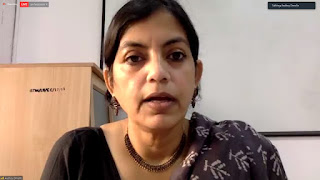
- "Why is marital rape not a crime in this country? And, my answer is marital rape is very much a crime in this country. It is not true that men can rape their wives. We have laws to deal with this... but it is true that it is not included in Section 376. However, in 1983, we, very clearly, got a law on Cruelty to wives which is covered in section 498A of the IPC."
- "In over 90% cases or more, the women mostly articulate this need that they are not being maintained; they are not receiving money from their husbands; they have been denied money from their husbands for their survival and that of that their children."
- "While women will describe in detail stories about violence - physical violence, physical abuse, beating (with hand and with objects), verbal abuse, and emotional abuse, they are very hesitant to talk about sexual abuse. And, it is very difficult to describe that incident in the same manner, and so, they don't talk about it till you draw it out from them. Even while they talk about it, the whole focus is on (seeking) relief."
- "When women have to kind of narrate those incidents of rape, it is extremely traumatic for them to describe it, and for the police when they are recording. That's why we know why so many women refuse to speak about it. Because of mandatory reporting, these cases are out there.....the whole journey of rape cases has led to a situation where the more high profile a case is, the more stringent is the punishment demanded. But, the more stringent the punishment is, the more difficult it is to get people to report."
- "Are we saying that [in terms of punishment] rape in a domestic violence situation is on a higher ground in comparison to other forms of violence like breaking one's head, starvation, physical abuse, etc? Are we putting rape on a pedestal in a situation of domestic violence? This, I feel, is problematic in more ways than one. If I have to take only sexual abuse in a marital context, denying sex is as much an abuse as forcefully having sex."
- "What we need is to look and re-look at section 498A. and bring more clarity into the definitions of sec 498A. Put out the different crimes that happen in a domestic relationship....let all crimes of domestic violence reach that level of stringent punishment. In domestic violence, all kinds of violence are interlinked. All kinds of violence are all there together, interplaying. We need to look at it as a whole."
Watch Audrey D'Mello's presentation here.

- "If one looks at the common law jurisdictions and the very, very infamous words of Matthew Hale, he had noted that a husband cannot be guilty of rape committed upon his lawful wife because of mutual contract...there is this notion of continuity of a form of consent that cannot be retracted."
- "If one looks at the Justice Verma Committee which has given a comprehensive piece on sexual violence, they had stated that marital rape stems from an extremely outdated notion of marriage which deals with wives as property of husbands. ....it states that the existence of a marital relationship is not a valid reason for sexual violence committed in course of a marital relationship"
- "Marital rape has come before the court on a number of occasions. If you look at colonial history, from Phulmoni Dasi, marital rape has triggered the age of consent debate..... the idea of consent debate, in colonial times, was about consent to have sex as long as you are not dead. It was understood in your physical ability to have sex and not die. The Phulmoni Dasi and Rukhmabai are the two cases that triggered the age of consent debate, and the passage of the age of consent act."
- "I am very uncomfortable with the idea of criminalization, to some extent......even if one criminalizes marital rape, will that make women come forward and talk about it?"
- ".....the language of Frankensteinian Monster, Legal Terrorism, etc has pervaded legal discourses and gone to the public arena, men's rights groups and they have invited these legal Delhi HC judges as keynote speakers. It is a give-and-take industry that continues to happen."
- "What does false complaint in law look like? There is a very evidential category...It is not always the case that everything can be proved. To prove something, you need a lot of other things. In the context of matrimonial dispute that is happening in the four walls of a home, you may not necessarily have a third party to witness it... We need to understand and talk about law a little more and understand that not proved and disproved categories are conflated...If it is not proved, it doesn't mean it is disproved and it doesn't mean automatically that it is a false case. What is the definition of false? Is there a legal definition of false in the IPC?"
Watch Jhuma Sen's presentation here.

- "During the COVID-19 pandemic, there was a high prevalence of domestic violence but marital rape has not been recognized. it is not a special provision on which the NCRB gathers data. So, we don't really know what is the data that is available."
- "The feminist demand in India has no unanimous position. But, I want to go back on what Jhuma ended her presentation with. Which is, to withdraw the exceptions of rape [between married and unmarried women]. Because, if you don't remove that exception, women's consent to sexual intimacy is irrelevant within marriage."
- "We are at a stage of hyper criminalization and further criminalization may only strengthen the arm of the state. In the current political context of India, it is a big question mark on whether we want to further criminalize marital rape or not.
- Over the last 15-20 years, even though 498A is a significant provision that was brought in, and to me, one of the main aspects of significance was that it was a significant statement the law was making that, what happens within the home is not something law will not intervene in. 498A, and then the Domestic Violence Act show very clearly that law does have a role to play whenever there is violence, even within the privacy of the four walls of the home."
- "Are we putting marital rape on a pedestal by criminalizing only marital rape and not other forms of sexual violence that deprive women of sex and so on? What is being argued here is not necessarily about criminalizing marital rape, but about removing exceptions to Marital Rape."
- "Some of the challenges we are facing to criminalizing marital rape - one is the legal challenge is to actually remove it like Justice Verma Committee suggested. Next is the social challenge where women internalize and accept marital rape. It is internalized patriarchy. Not just among men who think they can force themselves on their wives, but also among women who will accept and internalize it, and not even call it rape... it is a normalized form of violence among men and an internalized form of violence among wives. Leading to this is a political challenge; we see a lack of political will. We see that the state is not interested. We see that the parliamentary debate has been about we have a social and cultural milieu and marital rape provision will disrupt it. I would think in addition to legal challenges, we need to look at social and political challenges."
We also had the audience talk about how rape is considered the worst offense possible so much so that any other form of violence is "lesser than" rape, somewhere placing violence in a hierarchical structure. The question of false cases was also discussed and about the role of consent in navigating through the topic of discussion.
Watch the full panel video here.

