Showing posts with label gender violence. Show all posts

Wednesday, December 7, 2022

Day 13: Tamil Nadu Domestic Violence Support Services: A Mapping

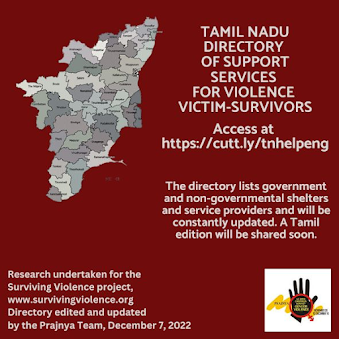
We are pleased to bring you a new Prajnya resource: the Tamil Nadu Directory of Support Services for Violence Victim-Survivors. This data was compiled for a mapping exercise of the Surviving Violence project (http://survivingviolence.org) and has been edited and updated by the Prajnya Team. At present, the directory includes information about five categories of support services for victim-survivors of violence, namely:

1. Swadhar Home

2. Family Counselling Centres

3. One Stop Centres

4. Protection Officers

5. All Women Police Stations


We will continue to add, update and will share a Tamil version soon. In the interim, do use and share the Directory at https://cutt.ly/tnhelpeng Thank you!

Saturday, December 3, 2022

Day 8: Stand in Solidarity or Sit in Silence! Poetry Reading

Images  by: Selvaraj 


On the 8th day of the 2022 Prajnya 16 Days Campaign Against Gender Violence, we partnered with Mockingbirds and InKo Centre and organised a poetry reading. This year, we had Srilata K, Kutti Revathi, Aaliyah Banu, Manushi Bharathi and Amrin Khalil reading their poetry.


The poetry reading covered a wide range of themes like body politics, domestic violence, religious identities and rights of transgender persons, to name a few. A few of the poets were also of the firm view that their work does fundamentally stay rooted in the idea that "personal is political".


“You see, Women must fight to be alive
The world isn't a nice place
For a woman, even the air she breathes is luxury
Something that is given to her
Something she will be held accountable for” 
- excerpt from Aaliyah's work, "The Angry Poem"

Kutti Revathi, in her conversation with Saradha U, for the TNM piece noted that, the performers provided the audience with a holistic perspective on the voices of women, with each poetry providing a different perspective, and acknowledging that the efforts made by the poets to put their voices out there is not easy (Saradha, 2022, as cited in The News Minute, 2022)


You may read the elaborate coverage of our event by Saradha U for The News Minute here.

Friday, November 26, 2021

Day 2: The Dowry Act at 60: A Review Panel

The year 2021 marks 60 years since the passage of The Dowry Prohibition Act (1961). However, 60 years later, it doesn't seem like a lot has changed. 

The second day of the Prajnya 16 Day Campaign Against Gender Violence was on contextualizing dowry, examining the dowry act, and tracing the various dowry-related movements. The 'Dowry At 60: A Review Panel' had Akila R (Advocate), Dr. Bharti Sharma (Activist, Shakthi Shalini), and Professor Sharada Srinivasan (University of Guelph) as the key panelists. The session was facilitated by senior journalist Ammu Joseph, who began by shedding light on how despite the campaigns launched by women groups against dowry and the changes in legislation, coupled with the changing perspectives of reports by the press on the issue, the problem of dowry demands and the resultant harassment of young newly-wed women continues to exist in our society.

A screenshot of the moderators and panelists taken using Zoom [a video conferencing platform]. The images have, in clockwise order from left to right Ammu Joseph, Bharti Sharma, Professor Sharada Srinivasan, and Akila R

clockwise [L-R]: Ammu Joseph, Dr. Bharti Sharma, Professor Sharada Srinivasan, and Akila R.


The audience was very lively, and towards the end of the session aimed to steer the discussion to a number of topics, including (but not limited to) the question of caste, the role of liberalization, the propelling of ideas through popular culture, ideas surrounding ostentatious weddings and the changes that have come to the forefront since COVID-19. 

You can watch a saved copy of the recording on our Facebook page or our Youtube channel.


An image of the first speaker Akila R
Our first speaker, Akila R opened the discussion by highlighting the legal remedies that are in place. She presented, in a concise manner, the various sections covered in the Dowry Prohibition Act (1961), and also drew us to the fact that laws formulated to protect women from demands of dowry and the resulting harassment have a gender-blind outlook.


  • "In addition to the Dowry Prohibition Act, there are several legal remedies for dowry demands and harassment. These may be civil in nature through divorce or matrimonial remedies or under the domestic violence act, and criminal through dowry prohibition act and other provisions of IPC."
  • "Through section 3 of the Dowry Prohibition Act, giving and taking dowry is an offense. Punishment has been enhanced now to over five years of imprisonment and a fine. What's interesting is that the law seems to accord the same gravity to taking and giving dowry. It is blind to the larger context of dowry.....they [the laws] are gender-neutral and context-neutral, and the implication or premise seems to be that giving and taking dowry is a choice."
  • "There are Dowry Prohibition Officers appointed and an advisory board in place. In Tamil Nadu, the District Prohibition Officers are designated as Dowry Prohibition Officers. They have a lot of important functions which help in creating awareness of the Dowry Prohibition Act."
  • "It is very interesting that there is Dowry Prohibition (Maintenance of Lists of Presents to the Bride and Bridegroom) Rules of 1985. It said that both the bride and the groom must maintain a list of presents given to them and that both parties must sign this....within one month of marriage, these lists are supposed to be submitted to Dowry Prohibition Officers...I can only imagine this creates a bureaucratic response."
  • "We have, over time, progressively increased the minimum punishment, but the reality is that when it comes to enforcement and taking cognizance, the law enforcement authorities and courts are not necessarily allies of victims of dowry....they approach with the presumption that this a false complaint and they are disgruntled wives. There is a rising very harmful rhetoric of how the law is abused. But, we have statistics that tell us that there is severe gross underreporting of crimes. The number of complaints of dowry deaths and dowry harassment is on the rise, but conviction rates are low. Despite the convictions being low, there is a rhetoric that complaints are false. Convictions may be low because of general faults in the system or women being forced to withdraw their complaints."
  • "There definitely is an aspect of Sanskritisation and this deeply entrenched idea that a woman has to be married off....there needs to be a rethinking of how families are structured and how relationships are structured...[in our society] dowry is not understood to be wrong but dowry harassment is understood to be wrong. It seems to be a part of our culture....unless we understand dowry itself to be a problem, it is quite difficult to proceed."

Watch Akila R's presentation here.

An image of the second speaker Bharti Sharma.
Dr. Bharti Sharma, our second speaker began her talk by sharing a couple of clips by Shakti Shalini Women Centre and led her talk by sharing the different experiences on dowry-related complaints that have come to the forefront.

  • "I would say that this particular cause [of dowry] lies in our socio-structure. This social structure, the Indian social structure, our social structure is deeply entrenched in gender inequality, power imbalance, and absolute gender norms that undermine the physical and mental health of survivors along with their dignity, their agency, their safety, and their autonomy."
  • "When a woman complaints, we have so far not come across, since 2010, a woman telling us that I am harassed on account of dowry. They talk about the violence they are suffering from, but dowry is never a reason why a woman or her family reaches out to us. So, it is very obvious that perhaps our society is not aware of the dowry act? Or, is it because we don't want to talk about dowry? Is it because then you have to go to court under the dowry act? We have to see why people do not complain about dowry."
  • "What is the use of legislation when it is not used? Does it not mean that something needs to be done to the legislation so that it is used? Our society knows that there is an evil of dowry still going on; they are both the victims and perpetrators."
  • "The law can be modified or amended. But the basic requirement is that we work at the level of the society and the community. Because this particular evil cuts across all aspects of the society; it doesn't see economic class, religion, caste, it doesn't see anything. It is everywhere. There are very few communities in the interior of India where there may not be any dowry situation. I would suggest that with this Prajnya 16 day movement, let us wake up and work together at the level of the legislations and the level of communities."
  • "It is very important that we work at the grassroots level - not only with men but also women...we have to devise different kinds of methods and strategies to work with different classes and groups of people to bring about the change."
Watch Bharti Sharmaji's presentation here.

An image of the third speaker Professor Sharada.

Prof. Sharada Srinivasan, our final speaker for the event explained the persistence or worsening of the practice of dowry despite the existence of legal remedies.

  • "Quoting from the abstract of my paper Daughters or Dowries? The Changing Nature of Dowry Practice in South India (2005), significant changes have occurred in the practice of dowry in South India. From being an upper caste/class practice, dowry has become an all caste/class phenomenon, replacing the symbolic exchange of gifts between families of the groom and the bride. It has become a euphemism for strategies to acquire higher standards of material life, status, and security, with negative consequences to women’s status, including their survival. The anti-female bias of the practice cannot be tackled from within the dowry trap. Raising the critical consciousness of women about their identity and self-esteem remains a critical component of effective strategies." 
  • "The way out of all of this is to really strengthen women's property rights and inheritance. That is really the way to fight dowry because we cannot fight dowry by taking part in the practice, right?..... The one clear way that legally is now possible is because of the amendment of the Hindu inheritance which allows for daughters to equally inherit ancestral property. So, that, I think is key to conquering the practice of dowry. This is easier said than done, I'm aware."
  • "Very often, in India and some parts of Tamil Nadu, people have always said there is a shortage of brides and presence of sex-selective abortion....the shortage of brides and demand for dowry operate on parallel tracks. The demand for a high-status groom has not gone down. If you need a high-status groom, you have to give a higher dowry."
  • "The middle-class weddings, nowadays, are a 3-day event with sangeet and mehandi. These events are often held at different venues showing the status of the girl's family and the groom's family. Events like the sangeet and the mehendi were not a part of Tamil weddings. These are recent additions."
  • "This notion that daughters are a burden and that they have to be handed over from the parents to the husband has to change among parents, daughters themselves and among husbands. This, of course, means that we work among men as well....education has to balance between individual liberalism and collective responsibility."
Watch Dr. Srinivasan's presentation here. 
Watch the panel recording here on our YouTube channel.

Thursday, December 10, 2020

பாலியல், சாத்திய வன்முறை - இறுகிய பிணைப்பு : கருத்துரை பற்றிய எனது பார்வை

பாலியல், சாத்திய வன்முறை - இறுகிய பிணைப்பு :
கருத்துரை பற்றிய எனது பார்வை

-- சுடரொளி


சாதியும், பாலிய வன்முறையும் - இது ஒரு பரவலான பொதுவான தலைப்பு! ‘இதில்

என்ன பேசிவிட போகிறார்கள் புதிதாய்!’ என்று எண்ணுவோரின் கவனத்திறகே இந்த

பதிவு.


x

 இதோ இந்த பேச்சாளர்கள், ஒவ்வொருவரும், கருத்துரையை கேட்டவர் அனைவர் மனங்களையும், தங்கள் பேச்சால் அசைத்து விட்டு சென்றனர் எனலாம். ஒருவர் தான் அறிந்ததை பேசுவதற்கும், ஒருவர் தான் அனுபவித்ததை சமூக பார்வையோடு சேர்ந்து பேசுவதற்கும் வேறுபாடு உள்ளது.  சாதிய சமூக பார்வையால் தனக்கு ஏற்பட்ட அனுபவங்களை (அவமானங்களை), ஒவ்வொருவரும் பேசும் போது, அவர்களின் கோபம்,  ஒரு சமூகத்தின் கோபமாய் கேட்போர் மனதில் நீங்கா ஒரு வலியை உணர வைக்கிறது என்பதை இந்த கருத்துரை எப்படி என்னை வெகுவாக பாதித்தது என்பதை கொண்டு உணர முடிகிறது. 


பொதுவாக, பெரும்பாலும் திருமண  அல்லது இல்ல விசேஷ அழைப்பிதழ்களில் தங்கள் பெயர்களின் பின்னால் சாதி பெயரை போட்டு கொள்வதுண்டு. நாங்கள் இந்த சாதியை சேர்ந்தவர்கள் என்று பெருமையாக சொல்லி கொள்வதாய் எனக்குப்பட்டதுண்டு. பேச்சாளர்கள் தங்களை இழிவுப்படுத்தும் நோக்கத்துடன் தனது சாதி பெயரை பொதுவெளியில்  பிறர் உச்சரித்து சுட்டும் போது, ஏற்படும் வலி, கோப கனலாய் அவர்களின் பேச்சில்  கொப்பளைப்பதை உணர முடிகிறது. கவிஞர் சுகிர்தராணி கூறும் போது, தான் சமூகத்தில் நல்ல நிலையில் இருந்தாலும், அவர் ஊரில்  ‘நீ சேரி சுப்ரமணியனின் பெண் தானே’  என்று தன்னை அடையாளம் அறிவதை கூறும் போதும், அதே போன்ற அனுபவத்தை சாலின் தோழரும் பகிர்ந்தார். அவரின் கல்லூரி காலத்தில், ‘நீ சேரி பொண்ணு தானே’ என்று கூறியதால், தான் தாழ்வு மனப்பான்மையால் ரொம்ப பாதிக்கப்பட்டதாக குறிப்பிட்டார். இதையெல்லாம் கேட்கும் போது, எவ்வளவு சாதிய அழுக்குகளை நம் சமூகம் சுமந்து கொண்டுள்ளது என்பதை நம்மால் உணர முடிகிறது.


ஊடகத்தை பற்றி குறிப்படும் போது, பாலினம் என்பதையும் தாண்டி சாதிய பாகுபாடு எவ்வாறு அங்கு வேரூண்டி உள்ளது என்பதை அறிய முடிந்தது. தலித்திய செய்திகளை கொணர்வதற்கு, தலித்தான தன்னை தேர்ந்தெடுத்ததாக தோழர் பிரியதர்ஷிணி குறிப்பிட்டார்.  திறமை மிக்க அவர் பிற செய்திகளை கையாள்வதற்கு தேர்ந்தெடுக்கப்பட வில்லை என்பது மிகவும் வருத்தப்படக் கூடிய விஷயமே! தோழர் கவின் மலர் குறிப்பிடும் போது, ஊடகத்தில் பெண் என்றால் சமையல் குறிப்பு போன்ற assignment தான் கொடுப்பார்கள். எடுத்துக்காட்டாக ஒரு பெண் நிருபர், ஒரு தலித் பஞ்சாயத்து தலைவர் அவமதிக்கப்பட்டு, கொலை மிரட்டலுக்கு உள்ளாக்கப்பட்டதை ஒரு செய்தியாக கொணர்ந்த போது, அதை எடுத்துக் கொள்ளாமல், ‘நீங்கள் சமையல் குறிப்பு எழுதி கொண்டு வாருங்கள்’ என்று அவமதிக்கப்பட்டார். இது போன்ற பாலினம் மீதான சாதிய வன்மம் தவிர்க்க இயலாது, ஊடகம் எங்கும் நிரம்பி வழிவதை பல்வேறு நிகழ்வுகளை கொண்டு விளக்கும் போது, அந்த நிதர்சனம் நெத்தி பொட்டில் அறைந்தது போன்று இருந்தது. 


பாலியல் வன்முறை என்பது எல்லா பெண்களுக்கும் ஒரே மாதிரியான நிகழ்வாய் இருப்பதில்லை என்பதும் நமது பேச்சாளர்கள் அனைவரும் சுட்டி காட்டிய உண்மை. தலித் பெண் என்றால், அவள் உடல் மீது அதீத வன்முறையை நிகழ்த்தி இந்த சமூகம் தனது சாதிய கோர முகத்தை காண்பிக்கின்றது. ஆசிபாவில் தொடங்கி, நம்மூர் நந்தினி வரை அனைத்து தலித் பெண்களுக்கும் இது நிகழ்ந்துள்ளது. ஹத்ராஸ் வன்புணர்வின் சாதிய கொடூரத்தை பற்றி பேசினால், ‘இது எல்லா பெண்களுக்கும் நிகழும் பாலிய பிரச்சனை தானே! அதற்கு ஏன் சாதிய பூச்சு பூசுகிறீர்கள்?’ என்றே பலரின் நிலைப்பாடாக இருக்கிறது. தலித் பெண் வன்புணர்வு செய்யப்பட்டால், அவளின் சாதிய அடையாளத்தை ஊடகம் வெளியிடுவதை  மிகவும் இயல்பானதாக கொண்டுள்ளது.  சிலர், தன்னுடைய தலித்திய அடையாளத்தை வெளிப்படுத்துவதுக்கு கூட தயங்குவதும் இங்கு குறிப்பிடத்தக்கதாக நமது பேச்சாளர்கள் குறிப்பிட்டார்கள். பெண்கள் என்றாலே வெளிர் நிறத்தில் இருப்பவர்களுக்கே வாய்ப்புகள், காட்சி ஊடகத்தில் கிட்டும் என்று ஊடக அரசியலை நம் முன் படம் பிடித்து காட்டினர் நமது பேச்சாளர்கள். 


அரசாங்க அமைப்பு மட்டுமல்லாது, இதர அமைப்புகளிலும் தலித்திய பிரநித்துவம் மிகவும் குறைவு என்பதும் நாம் ஒத்துக்கொள்ள வேண்டிய விஷயம். முடிவுகளை எடுக்க கூடிய பதவிகளிலும் தலித் பிரதிநிதத்துவம் குறைந்தே காணப்படுகிறது. அனைத்து பேச்சாளர்களும் கூறிய விசயம் என்னவென்றால், தலித்திய பிரதிநிதத்துவத்தை அனைத்து துறையிலும் அதிகரிக்க வேண்டும், என்பதும் பாகுபாடற்ற சூழலை உருவாக்க கூடிய ஒரு நிலைப்பாடாவே பார்க்க வேண்டியதுள்ளது.  


தனது வலி, அனைத்து தலித் பெண்களுக்குமான வலி அதனை இலக்கியமாக வெளிப்படுத்துவது, தலித் பெண்களின் வலியினை உலகுக்கு தெரியப்படுத்துவதே என்று தலித் இலக்கியத்தை பரவலாக்கி, அனைவரையும் அரசியல்படுத்த வேண்டும் என்று தோழர் சுகிர்தராணி கூறியது முற்றிலுமான உண்மை. இந்த வலியை ஏற்படுத்துவர்களை பற்றியும்,ஏன் இவ்வாறு நடக்கிறார்கள் என்பதை தலித் அல்லாத ஏனையோர் எழுதுவது அவசியம் என்றும் கவின் தோழர் குறிப்பட்டது, அவர்களின் வலியில் இருந்து பார்க்கும் போது சரியென்றே தோன்றுகிறது.


அனைத்து பேச்சாளர்கள் கூறியது போல, அனைவரையும் இந்த விசயத்தில் அரசியல்படுத்த வேண்டும் என்பதே இதற்கான தீர்வாக இருக்க முடியும். இதையெல்லாம் தாண்டி, தலித்தை தீண்டாத இந்த சமூகம், ஏன் தலித்தின் உடலை மட்டும் வன்புணர்ந்து, தீண்டுகிறது. ’அப்பொழுது எங்கே போனது இந்த சாதிய தீண்டாமை?’ என்று கருத்துரையில் பேச்சாளர் கேட்ட கேள்வி மனதில் தொக்கி, என்னை உணர்வு பிழம்பாக்குகிறது என்பதை மறுக்க இயலவில்லை.

Wednesday, December 9, 2020

Day 14: பாலியல், சாதிய வன்முறை - இறுகிய பிணைப்பு (கருத்துரையாடல்)


We have long wanted to organise programmes around the caste-gender violence connection but each time, our programme has run into problems and shifted shape. This year, we struck gold. We reached all the speakers we wanted, we were able to give them ample time and we were rewarded with a conversation so rich, it is impossible to summarise and must just be experienced. 

Our brilliant speakers were: 

  • Shalin Maria Lawrence, Writer and activist
  • Priyadharshini, Founder, The Blue Club
  • Priya, People's Watch
  • Sukirtha Rani, Poet and writer
  • Kavin Malar, Journalist
  • Vincent Kathir, Director, Evidence

Narmadha, Activist, facilitated the discussion.
We will be placing the video in its entirety on YouTube, as well as individual presentation clips. But in the interim, we urge you to watch the video as we live-streamed it on Facebook. 


Day 10: சுற்றத்தில் நோய், இல்லத்தில் வன்முறை: A Discussion on Domestic Violence during the Pandemic

We invited service providers from all the districts of Tamil Nadu to an afternoon of sharing and discussion around the increased frequency of domestic violence and other forms of gender-based violence during the pandemic lockdown. 

Thirty-three districts were represented by 24 NGOs, some of whom worked primarily in the area of domestic violence support services and others whose work brought them into contact with survivors whom they went on to help. Prior to the meeting, NGOs filled out a short survey. We will compile those findings and notes from this discussion into a report before Pongal 2021. 

Some common experiences and themes that were mentioned in the presentations:

  • All types of violence became more common during the lockdown. Apart from domestic violence, participants mentioned:
    • Child Marriage
    • Forced Marriage
    • Child Sexual Abuse, often by old people.
  • There were also caste-related consequences: One NGO representative narrated the story of a young man, about to marry out of his caste before COVID, who married according to his family's wishes in order to have their support during the pandemic. 
  • Economic distress led to women being unable to repay microcredit loans. This led to arguments and violence.
  • Men being at home all day increased the workload at home and also led to friction over money and violence.
  • Social workers could not travel to check on clients who were known to experience domestic violence, and victims could not travel to seek help. In the constant presence of abusers, phone calls were also not an option.
  • Victims were unable to reach shelter homes because COVID tests were required. One NGO mentioned that women who came to the shelter during COVID were unusually unwilling to go back home.
  • Alcohol consumption by men sitting idle was related to increased domestic violence. One NGO representative said, "We could write an episode on before and after TASMAC. After the opening of TASMAC, the men started hitting their wives to ask for money to buy liquor."

This summary barely captures the richness of the discussions. There was great interest in follow-up activity and suggestions included:
  • Consultations over a longer duration on this topic.
  • Camps to help women register domestic violence cases.
  • A collective voice to raise these issues and also to access data.
  • Capacity-building for NGOs who may not specialise in, but need information about gender-based violence and laws.
We were overwhelmed by the response and enthusiastic engagement by our partners but dismayed that some of them had to struggle with connectivity issues and could not make their presentations. In this information age, we were reminded that the digital divide has not been bridged at all. 

Wednesday, December 2, 2020

Day 7: Inclusive Equality: A Workshop | @ecfindia #ProjectRaise

    On the 7th Day of the 2020 Prajnya 16 Days Campaign Against Gender Violence, we had trainers from the Equal Community Foundation share insights from their work and offer strategies for including men and boys in the journey towards gender equality and a violence-free world.


    The workshop began with an ice-breaker on the participants discussing what they have learnt from the pandemic. From the mention of the kind of resilience folks facing caste atrocities have shown to the need to express gratitude visually, a wide array of responses were given. Antika, the facilitator, from Equal Community Foundation, then, took the participants through a session on Inclusive Equality, where she highlighted that one needs to believe that men and boys are capable of change. This, she pointed out, can occur through facilitation, skill-building, and visual aids, to put together a participatory session that makes men and boys reflect on their experiences.


    She began by conducting an "Island Activity", where the participants were advised to close their eyes and imagine being stranded on an island. Antika then proceeded to ask what one would need in order to survive. Initially, the responses centred around shelter, food, clothes and companionship. Towards the end, the focus was laid on the need for an administrative setup, legislation, political awareness and freedom of speech, to name a few. All these points, she mentioned, are necessary for an individual to live with dignity in a society.


    Antika said, "When we talk about gender discrimination, it is a human rights issue. When we talk of masculinity, it is a human rights issue. Anything we see must be viewed through a human rights perspective. So, when one comes from the point of privilege, it is difficult for them to understand why they should let go of their privilege. To understand the need to give up one's privilege and uphold human rights is why these rights need to be talked about and inculcated in every issue."


    The discussion, then, steered towards actioning a meaningful dialogue. This was raised by a participant who mentioned how individuals who realise their privilege stop interacting entirely. Antika responded by saying, "it is necessary for us to have the right attitude. One's privilege has to be acknowledged and has to be given away. And, it is the most difficult thing to do. It is not an easy process. The society doesn't help either. What we can do is build safe spaces around that person. This accelerates our change and helps us give away our privilege bit by bit [without feeling guilty] by knowing that one has changed, reflected and reinvented themselves."


    She also emphasised on the need for inclusivity as facilitators. She said, "what we need as facilitators are to be more inclusive - in our language, sessions and presentations. We can begin by talking about gender. We can then move to sex. Through this, we get into the conversation that the topic isn't limited to men and women." She also mentioned that there is a lot of secrecy and mystery concerning topics like the body, bodily autonomy, sexual and reproductive health or sexual orientation, and a repeated mention of the same in various discussions with men and boys is necessary to break the taboos.


    The webinar ended with a participant quoting Dr B.R. Ambedkar's views on human rights: "as experience proves, rights are protected not by law but by social and moral conscience of the society. If social conscience is such that it is prepared to recognise the rights which law proposes to enact, rights will be safe and secure. But if the fundamental rights are opposed by the community, no Law, no Parliament, no Judiciary can guarantee them in the real sense of the world."


(Screenshots by Pozhil SG)

Wednesday, December 5, 2018

Day 10: Equality, Diversity and Safety: A tweetchat on Workplace Sexual Harassment

On day 10, we scheduled a Tweet chat on workplace sexual harassment which was facilitated by Dr. Shakthi S. The tweet chat was a scheduled from 12 - 2 pm.

The tweet chat began with open questions to twitter community on workplace sexual harassment

Here are some excerpts:


Wednesday, December 28, 2016

What's the story?

That's what we wanted to know. All of us at Prajnya love to read and between us, there's probably no genre of fiction that remains explored although of course, each one has their favourites. None of us reads to make a point about ourselves, and we love talking about books.

When you think about it, it's quite surprising that we hadn't organised a discussion about gender violence in fiction all these years. We've done other literary things--creative writing and poetry readings galore--but nothing with fiction.

Once the idea occurred to us, the format and the structure were both no-brainers. We wanted discussion leaders to start off the conversation but in an almost-off-the-cuff way and briefly. We knew what we wanted them to ruminate over. What is it that is so seductive about patriarchy that we continue to read fiction that starts and ends with patriarchal assumptions--for instance, romance novels? What do we make of fiction where the 'hero' is a 'heroine'--or to put it in more inclusive terms, where the protagonist is not a man? If those books are to be classified as 'literature', do they have to have violence? Is violence the hallmark of realism and realism the prerequisite of something being called 'literature'? And what about consent? What is the place of consent in fiction?

Of course, the four avid readers we invited to lead the discussion used our questions as a point of departure for their own explorations, rather than exam question papers!


Lavanya Gopinath spoke about Regency Romances and raised questions about contemporary romantic fiction that she invited the audience to answer. Archanaa Seker systematically reviewed several kinds of popular fiction in search of the protagonist who is not a man. Samyuktha PC contempated the ubiquitous violence in young adult fiction, concluding provocatively that it was perhaps essential! Archana Venkatesh discussed consent in a few different books including Perumal Murugan's One Part Woman--incidentally this was perhaps the only South Asian work that was discussed that day!

The discussion that followed was spirited as people spoke in defence of literature they loved as well as with outrage about the things that infuriated them. Clearly there is a place in this town for regular book discussions and there is no shortage of passionate readers!

Crossword generously partnered with us to provide the venue for this event. We look forward to working with them in the future.


Sunday, December 4, 2016

Disability, sexuality, gender and violence: Chat with @saysnidhigoyal

On December 3, World Disability Day, we spoke to disability and gender rights activist Nidhi Goyal (@saysnidhigoyal) about sexuality, disability and violence. Some snippets:


Read the full chat, storified here.


Friday, December 2, 2016

#SexTalk: Tweetchat with Bishakha Datta

On Day 7 of the 2016 Campaign, we went on Twitter for a chat with Bishakha Datta, the founder of PoV Mumbai, on gender, sexuality, technology and violence.


We discussed why working class men watching porn disturbs people so much.


We talked about sex, porn, consent, technology, surveillance, and the whole chat has been storified here.

Wednesday, December 10, 2014

Community Cafe: Exploring GV - CyberSmart Parenting


On the 9th of December, we met with parents of prepubescents and teenagers to discuss cybersmart parenting and how to equip children to deal with online violence and more importantly, foster an open environment where kids feel comfortable opening up to their parents when they do encounter violence.

The session began with a presentation by Anupama Srinivasan of Prajnya. Some of the issues that were flagged up during the presentation were:

  • The online habits of both parents and children
  • Usage in terms of time and content and information shared on online portals
  • Cyber-bullying which includes abusive texts and emails, posting unkind or threatening images, videos or messages on social media websites, inappropriate image tagging etc..
  • Where to draw the line between what is private and what is public. 
  • The importance of digital reputations in securing higher education and career opportunities.
  • The crossover from offline violence to online violence and its repercussions

In the discussion that followed, the following opinions and concerns were shared:
  • Many parents had no idea what their children did online
  • It was believed that parental controls were not really useful in regulating online behaviour and children found a way to bypass them. Other measures, such as a 9 PM ban on all electronics, no whatsapp after 9 and placing computers in living rooms or having an open door policy when kids were on the laptop were suggested.
  • Related to this, a majority of the group felt that their children were far more tech-savvy than they could ever be and therefore felt that it might not be easy to navigate behaviour on a medium that they were unsure of. In this regard, a parent commented that while "they were internet immigrants, their children were internet natives".
  • A recurring concern was the need to make sure that children approached their parents when they were being bullied or harassed on cyberspace.
  • The prevalence of closed confessions groups on social media where people could post anonymous rumours was also pointed out and many parents felt that the school needed to take some responsibility in sensitizing children about online violence and mediating altercations.
  • The issue of what to do when your child is the bullier rather than the bullied was also addressed.
  • In case of online-violence, it was emphasised that victim-blaming in these instances would lead to further alienation and hurt. 
  • Sexually explicit online content, cyber-stalking, victim-shaming and sexting were also touched upon.
  • A small group of young adults who attended the session had this to say: They stated that while much of the information provided made the online world seem very bleak, parents should not broach the subject with their kids with panic or fear. That policing internet use and the fear of punitive action would lead children to find other avenues to get online and hide it from their parents. Rather than taking away their children's freedoms, it would be essential to have open, honest conversations about online behaviour.
  • It was unanimously agreed that follow-up sessions with the kids as well as one with both groups together would be extremely useful to further the conversation.
A big Thank You to our GEM Rinku Mecheri, for being such a wonderful host!

Community Cafe: Exploring GV - What can Men Do?


On 6th December, as part of the 16 Days Campaign Against Gender Violence, we held our first ever Men and Boys Community Cafe led by Sriram Ayer of Nalandaway. It was a conversation that touched upon some uncomfortable truths and built platforms for many more productive actions.

"Men are the protectors. It is their job to care for women" - This is a commonly held opinion that we find expressed in many forums and not many of us find fault with these kind of statements. In fact, we actively believe that the opposite of violence is a kind of chivalry characterized by a protective instinct. The group discussed how such characterizations impact men, women and the choices, opportunities and resources available to them.

The session began with a 'Spin a Yarn' session where a primer line for a story is given and everyone adds to it, in turn. It started with a young man on his way home from work, who spots a young woman smoking on the road. The story changed in perspective and tone as each of us took turns adding to it. It raised many problematic themes about how women are viewed, what we believe is appropriate behaviour for women and the conditions we place on their use of public spaces.

It was a great starting point for a brisk and practical discussion on gender violence and its many forms, from homes to workplaces to the street and the conversation centred on what can be done to change how things stand and what each of us can do, individually and collectively to make a difference.

Here are some of the points that were raised:


  • As a society, we have set standards for masculinity and femininity and this sets unfair and forced expectations for both men and women.
  • Girls and boys are raised with different sets of rules and this automatically impinges on women's freedom and choices.
  • As bystanders, how can interventions be made - The space between doing nothing and doing something extreme, such as approaching the police was discussed.
  • A question was raised about why interventions were skewed towards survivors and in what ways society can intervene to change perpetrators. While prevention mechanism in terms of education and attitude change and targeted interventions with young people were raised, the idea of changing violent behaviour among offenders was a far more complicated issue than could be discussed in 2 hours.
  • Individual actions were also discussed and many practical suggestions were made including the use of social media to spread messages about gender and violence as well as initiating many more dialogues such as this and engaging in sustained conversation about GV.


Thank you Sriram Ayer, for being such a wonderful host!

Thank You, EZ Vidya!


Prajnya is proud to have EZ Vidya as our Corporate Campaign Partner for the 16 Day Campaign Against GEnder Violence for the second year running. Here's what Chitra Ravi, Founder and CEO of EZ Vidya, has to say about our association. 


A Note from Chitra Ravi, Founder & CEO EZ Vidya


We, at EZ Vidya believe that a humane approach & sensitivity to fellow beings  are the most vital aspects for a peaceful society, where there is mutual respect and acceptance. Gender sensitivity is an important element even in education, the business we are in!

Prajnya creates awareness and works on empowering individuals to understand Gender sensitivity as well as sensitive topics like gender violence. We believe that our workplace should be harmonious, devoid of any gender discrimination and of course with a big NO to gender violence of any kind. So, Prajnya became our natural partner in creating a highly sensitive workplace. Thanks Prajnya!


Community Cafe: Exploring GV - Learnt Violence, Taught Equality


We co-hosted our first Corporate Community Cafe of the 2014 Campaign Season on 5th December with the lovely people at EZ Vidya. The Community Cafe is a format that allows us to approach gender violence from many angles and perspectives and each group of people we do it with put their impress on the conversation in different ways.

In prevention and response to Gender Violence, we often talk about multi-sectoral interventions. There are many layers and complications to traverse and requires work at every level. At EZ Vidya, we sat down with a mixed group of people of different ages, gender and experiences but with a common passion for education. As people engaged in re-defining the way teachers teach, children learn and content is shaped, the conversation followed two main themes:

  • The Gender Stereotyping that steers children towards certain hobbies, activities and careers as appropriate for their gender and the subsequent consequences for children of all genders was discussed at length. For example, men are often pushed towards Engineering or Management to gear them to being breadwinners and denying them avenues to pursue their passions and women are stripped of responsibilities and choices in this regard, leaving them free to choose careers in the arts or sciences but simultaneously denying them equal opportunities. 
  • A large part of the discussion focused on how children can be raised and taught in gender-sensitive and gender-equal ways. EZ Vidya's work on re-shaping curriculum was also highlighted. In their new social studies books for primary classes, men and women are both portrayed as heads of families and both have careers and do housework. The family is explained as a collaborative unit and no gender-specific roles are assigned, thereby challenging stereotypes that we often take for granted, such as mothers cook and fathers work. 
The people at EZ Vidya strongly believe that focusing on children and changing what we teach them, the manner in which it is taught and the people who teach are critical pivots in altering the discourse on gender and violence. We hope this is the first of many such conversations.


Community Cafe: Exploring GV - From Mythology to the Workplace


An insightful conversation led by GEM N.Shekar, the group traveled from women in mythology to women in workplaces to discuss gender stereotypes and the cultural norms that influence attitudes and behaviour.

Before the community cafe began, an enthusiastic discussion about Kamba Ramayanam revolved around Kaikeyi and the good woman - evil woman dichotomy. Her love for Rama was juxtaposed with her need to secure Bharatha's claim over the throne. Alternative interpretations were discussed and the need to go beyond black and white representations was recognized.

Moving on to modern workplaces, the new Workplace Harassment Law and the increasing awareness in recognizing violence in the workplace and building systems that can effectively intervene was noted. The importance of understanding that each of us have personal boundaries that differ and what is okay and normal for us might not be for another was also raised. Where systems do exist, the difficulty of navigating rules that are not clearly defined and are based on personal perceptions of safety and appropriateness was debated vociferously.

That systems are not perfect and are populated by individuals from diverse backgrounds and therefore challenges in both implementation and interpretation will still persist is a given, but having them initiates a culture of openness and zero tolerance towards violence. It also helps challenge prevalent notions about our expectations of how women and men "should" be.

Thank you N.Shekar, for being such a wonderful host!

Community Cafe: Exploring GV - Where Freedoms End


Why are we squeamish to talk honestly about sex? Why are we so apathetic to the violence that surrounds us? Where do we draw the line between personal freedoms and our duties and responsibilities - as individuals, citizens, professionals and members of a family unit? And why are these lines harder to blur for women that they are for men? 

These are some of the questions that were raised in our 2 hour conversation on the 7th of December with our GEM Jayanthi Karthikeyan and members of her Reiki Satsang. Even as the group debated existing realities, the focus was on prevention and response and what each of us can do, as individuals, to change the status quo. In this sense, it was a conversation that mirrored the larger purpose of the campaign itself.

An important point that was raised during the course of the conversation was about how we learn. When we are in school, while the content is the predominant focus, the real learning is the acquiring of schemes that help us process information a certain way and the cultural norms that influence this. Violence as a learned behaviour follows the same patterns and is influenced by the same norms: How can we change the way we raise and teach our children? And how can we treat girls and boys equally?

Thank you Jayanthi Karthikeyan, for being such a wonderful host!

Tuesday, December 9, 2014

Meet Our GEMS: Rinku Mecheri

The Blurred Lines Between Physical & Cyber Safety
by Meera Srikant


Rinku Mecheri is the founder of Chennai Volunteers, a social initiative that works towards enhancing awareness on the role of individuals in society.  It drives civic engagement by facilitating volunteers to make meaningful skill and time contribution to beneficiaries and NGOs in a sustainable and meaningful way. The organization facilitates the process of building a more supportive infrastructure for nonprofit organisations, and simultaneously enhance the experience of volunteers and create awareness on social issues. CV leverages the online medium with a dynamic web portal, where: volunteers can find various opportunities to share and care, members can find local/international partners and NGOs can share resources and exchange best practices, 24x7. Mecheri shares her reasons for being a part of the Prajnya campaign.
Why is this issue important to you?
In all the roles that I have adopted in my life till now – a young girl, a teenager, a professional, a spiritual seeker, a mother and, of course, an active volunteer for various causes, “safety” has always been an important part of my well-being quotient. It did not matter which part of the country I lived in or which corner of the world I travelled to, it has always been reiterated.

I see that the same holds good for the youth of today as well. Personal safety is an issue we all mentally tick off before we look at other aspects pertaining to them. In fact, it is more of a concern now, with the cyber world being such a big part of their lives. Cyber-bullying takes old-fashioned threats, harassment, and humiliation into the virtual world and allows people to attack each other quickly, persistently, somewhat anonymously from any part of the world. We keep reading of Internet predators, identity theft, phishing but they are words we have limited knowledge. In such a scenario, how do I protect my young teenager from a click-happy habit that is the norm today?

We need to be safe in our belief of being equal as a woman. And we need to be safe by having enough knowledge about the negatives of the cyber world. 

What is it you feel most strongly about?

Personal safety no longer pertains to physical safety alone. There is an added component of cyber safety that I feel has many grey spots that I may not even be aware of. When I venture out to work or volunteer into any corner of both worlds – real and virtual, I want to be safe. I also want the children and women I work with to be aware and, hence, safe.

Tell us about your activity and what you hope to do with it?

Chennai Volunteers is hosting a conversation on the topic "Safety in Equality" with emphasis on Cyber Safety for youngsters.

Planned as a dialogue with parents of teenagers (boys and girls), this promises to be an interactive session that will be led by the Prajnya team. We also have a special resource, Ms. Ruchi Mohunta, who will actively moderate this session for us. She brings with her, years of experience in teaching, counselling and enhancing leadership skills of young teenagers.

Three things you would suggest to keep these individual actions going.

While this is the first step, I feel we need to expand the reach of such discussions and keep them going. We would then be able to enhance awareness and maybe even help some youngsters who have been victimized. My immediate focus area would be the volunteers we work with.