Saturday, December 3, 2022

Day 8: Stand in Solidarity or Sit in Silence! Poetry Reading

Images  by: Selvaraj 


On the 8th day of the 2022 Prajnya 16 Days Campaign Against Gender Violence, we partnered with Mockingbirds and InKo Centre and organised a poetry reading. This year, we had Srilata K, Kutti Revathi, Aaliyah Banu, Manushi Bharathi and Amrin Khalil reading their poetry.


The poetry reading covered a wide range of themes like body politics, domestic violence, religious identities and rights of transgender persons, to name a few. A few of the poets were also of the firm view that their work does fundamentally stay rooted in the idea that "personal is political".


You see, Women must fight to be alive
The world isn't a nice place
For a woman, even the air she breathes is luxury
Something that is given to her
Something she will be held accountable for” 
- excerpt from Aaliyah's work, "The Angry Poem"

Kutti Revathi, in her conversation with Saradha U, for the TNM piece noted that, the performers provided the audience with a holistic perspective on the voices of women, with each poetry providing a different perspective, and acknowledging that the efforts made by the poets to put their voices out there is not easy (Saradha, 2022, as cited in The News Minute, 2022)


You may read the elaborate coverage of our event by Saradha U for The News Minute here.

Friday, December 2, 2022

Day 7: Responding to Domestic Violence: A Training for Social Work Students


On December 1, 2022, ACR Sudaroli facilitated a workshop on how to recognise and respond to domestic violence. The training workshop was meant for social work students and early career social workers. Given that one in three women experience abuse, the probability of their encountering a victim-survivor is high and the purpose of the workshop was to give them some skills to be a first responder. 

The training session covered the following points: 

  1. What is Domestic Violence? 
  2. Why does it happen/ how is it justified? 
  3. As a social worker, how do you recognize that domestic violence may have happened?
  4. Challenges of help-seeeking
  5. How can you help?

The section on challenges of help-seeking drew on the findings in Tamil Nadu of the Surviving Violence project, for which Sudaroli was the senior field researcher. This training is part of the outreach work of the research project. 


Thursday, December 1, 2022

A Conversation on Gender Violence against Religious Minorities


 On Wednesday, November 30, 2022, the campaign went to Ethiraj College Department of Human Rights. We had invited Bader Sayeed, eminent lawyer, former Tamil Nadu MLA and founder, Roshni (NGO) to participate in a conversation with Vaishna Roy, editor, Frontline.

Ms. Roy's questions placed topical issues like the hijab controversy and the new triple talaq law in the context of broader constitutional issues as well as everyday politics. They underscored how structural issues are a part of gender violence too.

Ms. Sayeed's responses reflected the multiple intersections or perspectives from which one can take a stand on these issues--cultural citizenship; the outsider-ness of minority status; an individual woman's point of view and that of a litigation lawyer. She urged students to be politically engaged and to consider political careers. Her comments also made clear that there are no clear-cut positions on complex issues and that one would have to engage with the issues afressh each time. 


Wednesday, November 30, 2022

Day 5: Local Committees, Remote Justice

On the 5th day of the 2022 Prajnya 16 Days Campaign Against Gender Violence, a discussion on "Local Committees, Remote Justice" was organised. In this structured discussion on Local Committees, their challenges and awareness of them, the Tamil Nadu Labourers' Rights Federation and Gramavaani presented the findings of a survey they conducted to gauge awareness of Local Committees in Tamil Nadu. This was followed by a presentation by Prajnya's Rajaram Research Fellow Preeti Karmarkar of her research on Local Committees in Maharashtra. The session started with videos in Marathi, Hindi and Tamil on workplace sexual harassment which you can find here. You may find a saved video of the recording here. 


The discussion began with a short overview of a study conducted on the Level of Awareness on ICC/LCC among women workers, facilitated by the Tamil Nadu Labour Rights Federation (TLRF). TLRF largely works with the unorganised sector, where the ICCs and LCCs are poorly implemented. Gramvaani, a partner of the project, tried to take this campaign to a larger audience. Richardson, of the organisation, mentioned that, initially while the issue was brought to the forefront, there was no data to supplement the same. Post this, testimonials were collected from labourers and a survey was shared in 2020 to serve the purpose outlined earlier. The survey results showed that 27% of the respondents were construction workers, followed by 22.7% engaged in the agricultural sector, under the MNREGA. The responses showed that 80.5% of the respondents had not faced harassment in their workplace. This was a contradiction to the experiences from the field, where interactions with labourers show instances of harassment (though they may be hesitant to share the same). TLRF also filed RTIs in three districts to know the situation of LCCs and found that of Madurai, Virudhunagar and Dindugal, only the district administration of Dindugal provided details of the LCC. During the course of the discussion, Latha from Dharmagiri district also highlighted the experiences of women engaged in several unorganised sectors (construction, garment, health workers and women working in pharmacies) with respect to workplace sexual harassment. Additionally, she also highlighted the experiences of students in schools and colleges, particularly during the pandemic.


This discussion was followed by Preeti Karmarkar, a Rajaram fellow, who highlighted the functioning of Local Committees in Maharashtra. The study employed using a feminist socio-legal approach to gather data. The striking finding across the entire study area is that there is not one complaint from the unorganised sector in the LCs. The complaints from the organised sector that the LCs have received have been primarily against the employer. When the LCs received complaints, they conducted inquiries and gave recommendations. Additionally, Preeti also highlighted the challenges faced by the LC members, and further explained the methods through which LCs could be strengthened. Dr. Anagha Sarpotdar also supplemented the discussion with her experiences from the field.


About the Speakers:

1. Dr Anagha Sarpotdar: Social Scientist by Training Specialising in Work Aimed at Combating Workplace Sexual Harassment and she is a Consultant, Trainer, Author, Researcher, and does Workplace Sexual Harassment Inquiries (Based in India, Mumbai)

2. Preeti Karmarkar: Managing Trustee at Nari Samata Manch, she is trained as a Social Scientist and Gender expert, Preeti is associated with Nari Samata Manch since 1998. She has 22 years of experience in social development field in the areas of grassroot mobilization, project development and Management, M&E, policy as well as investigative research and NGO management with national and international exposure. She is an experienced gender trainer and provide consultation for gender integration in programme. She also provides training/consultation for implementation of Sexual Harassment of Women at Workplace (Prevention, Prohibition and Redressal) Act, 2013 and work as external members for renowned organizations. Earlier she has worked at Women’s Studies Centre (University of Pune), YASHADA and BAIF Development Research Foundation.

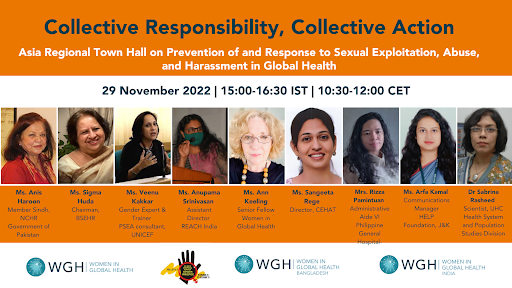
Day 5: Collective Responsibility, Collective Action

Rapporteur: Farheen Nahvi

On day 5 of the 2022 Prajnya 16 Days Campaign Against Gender Violence, Women in Global Health hosted its third regional town hall on the Prevention of Sexual Exploitation, Assault, and Harassment (PSEAH), which focused on the Asian region, in collaboration with the Prajnya Trust. 


The event brought together representatives from CSOs, governments, international organisations, and activists to continue the conversation on the need to develop regional collaborative mechanisms and reaffirm our commitment to eliminate SEAH. 

The keynote remarks were delivered by Dr. Poonam Khetrapal Singh, Regional Director for WHO South East Asia; and Ms. Anis Haroon, the Sindh representative of the National Commission of Human Rights, Pakistan. The event was moderated by Ms. Anupama Srinivasan, Assistant Director at REACH, India. 

Other speakers and panelists included:

  • Ann Keeling, Senior Fellow, Women in Global Health

  • Dr Sabrina Rasheed, Scientist, ICCDR,B; and lead for the Bangladesh chapter of Women in Global Health

  • Ms. Veenu Kakkar, Gender Expert & Trainer; PSEA consultant with UNICEF

  • Mrs. Rizza Pamintuan, PGH Women’s Desk

  • Sigma Huda, President of Bangladesh Women Lawyers Association (BNWLA); Founder & Secretary of Institute for Law and Development (ILD)

  • Arfa Kamal, HELP Foundation Kashmir

  • Ms. Sangeeta Rege, Director, CEHAT (Centre for Enquiry into Health and Allied Themes) 


Watch the video of the event here

Tuesday, November 29, 2022

Day 4: Surviving Violence: Everyday Resilience and Gender Justice Webinar

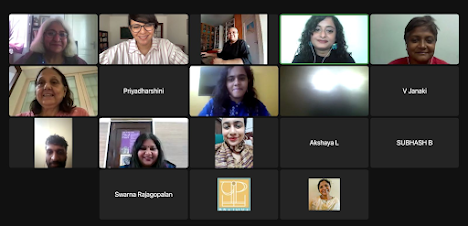
On the 4th day of the 2022 Prajnya 16 Days Campaign Against Gender violence, the 'Surviving Violence: Everyday Resilience and Gender Justice' webinar brought together the findings of a three-state research project on help-seeking experiences of domestic violence victim-survivors. The presentations were made by Girija Godbole, IIT Bombay and Preeti Karmarkar, Nari Samata Manch on Maharashtra; RNandini Ghosh, Supurna Banerjee (Institute of Development Studies Kolkata) on West Bengal; and Swarna Rajagopalan (Chaitanya) on Tamil Nadu. Shakthi S. (Prajnya) facilitated the event. You may find a saved copy of the recording here. 

This panel is part of the research project Surviving Violence: Everyday resilience and gender justice in rural-urban India funded by the British Academy Heritage Dignity and Violence Programme HDV190009. Research partners: Queen Mary University of London, Chaitanya-The Policy Consultancy, Indian Institute of Technology Bombay, Institute of Development Studies Kolkata, Nari Samiti Manch and University of Oxford.


Findings from Maharashtra: Girija Godbole (IIT Bombay), Preeti Karmarkar (Nari Samata Manch).

  • "When we spoke to the survivors, almost 80% of them said that they had suffered all types of violence such as physical, sexual, emotional, verbal and economic. The most common reasons were liquor addiction and/or extramarital affairs of the husband, coupled with suspicion about the wife by the husband."
  • "Most survivors said that the first persons they spoke to were typically their parents. For informal mediation, the first attempt is to organise a family meeting to discuss and resolve the issues."
  • "In the rural sides, where we have tribal groups, we also saw that two survivors approached the tribal council in their villages. In one case, the survivor consulted the tribal council in her village, but she wasn't happy with the verdict. So, she approached the court. And, the tribal council wasn't very happy about the situation, that she went out of the village. And they put a lot of pressure on her to withdraw the case. She decided to go to a higher level of the tribal council, which is the circle council. There was one member there who was sensible and sensitive and took up her cause, and he tried settling the case. Then, she withdrew the case from the court, and she was satisfied with the verdict."
  • "We asked them (survivors), what according to them is domestic violence?...their definition of domestic violence is very well consistent with the definition as given in PWDVA, 2005, that is, they recognise non-physical forms of violence also."
  • "One very important suggestion, that came from a lawyer that we interviewed is that, PWDVA matters should be allowed in the family court. At present, they are heard by the Judicial Magistrate First Class."


Findings from Tamil Nadu: Dr. Swarna Rajagopalan (Chaitanya)

  • "What emerges from the stories that we primarily heard from survivors but also from community members and service providers in the state, formal and informal, is really that, women are stuck. They are hemmed in by patriarchy, socio-economic inequities and escape hatches and drawbridges and support services that they do not know about, that they cannot access and that, sometimes, simply don't work. But still, the fact that 61 of them sat through the interview and told us their stories makes this also a story of resilience."
  • "If the first question of intersectionality is, 'does this form of identity affect the experience of violence, of help-seeking, of access to justice', then the answers in our data, in Tamil Nadu, are not pronounced enough to headline the research"
  • "We wanted to know how people coped/lived with violence and most women felt safest in their natal home, and most unsafe in their marital home."


Findings from West Bengal: Dr. Nandini Ghosh, Dr. Supurna Banerjee (Institute of Development Studies Kolkata)

  • "We have not found any significant caste differences, but echoing the other two teams, what we have found is that there is never a single form of violence happening. What happens is that there are multiple kinds of violence. The verbal and physical are often taken for granted."
  • "Legal aid, which is free, has largely been ineffective. So there has been lack of financial and infrastructural support from the state, and this is what the lawyers tell us. Most of the survivors too reiterated this."
  • "While there are laws and institutions to protect survivors of domestic violence, there is an entire gamut, an entire structure (the informal help-seeking) that operates outside of this." 
  • "It was evident that domestic violence was embedded in the social hierarchies of power, of dominant heteronormative, caste, class, and gender interests."


About the Speakers:
1. Supurna Banerjee is faculty in Institute of Development Studies Kolkata (IDSK). She researches labour, gender, violence, migration and intersectionality. Her monograph Activism and Agency in India: nurturing Resistance in Tea Plantations was published in 2017. She has published in various peer reviewed journals such as Gender, Work and Organisation, Oral History and JSAD. She has co-authored Limits of Bargaining: Capital, Labour and the State in India Violent Domestic: 𝙇𝙖𝙬, 𝙞𝙩𝙨 𝙋𝙧𝙖𝙘𝙩𝙞𝙘𝙚, 𝙖𝙣𝙙 𝙎𝙩𝙧𝙖𝙩𝙚𝙜𝙞𝙚𝙨 𝙤𝙛 𝙎𝙪𝙧𝙫𝙞𝙫𝙖𝙡.

2. Nandini Ghosh is Assistant Professor, Institute of devlelopment studies, Kolkata, PhD in Social Sciences, Tata Institute of Social Sciences, 2008. Books Published - Impaired Bodies, Gendered Lives: Everyday Realities of Disabled Women, New Delhi: Primus Publishers, 2016 Books Edited, Caste and Gender in Contemporary India: Power, Privilege and Politics, (Jointly with Supurna Banerjee), New Delhi: Routledge, 2019 Interrogating Disability in India: Theory and Practice, Springer, 2016 Pratyaha: Everyday Lifeworld: Dilemmas, Negotiations and Conflicts, (Jointly with Prasanta Ray), New Delhi: Primus, 2016., Hyderabad.

3. Preeti Karmarkar, Managing Trustee at Nari Samata Manch, she is trained as a Social Scientist and Gender expert, Preeti is associated with Nari Samata Manch since 1998. She has 22 years of experience in social development field in the areas of grassroot mobilization, project development and Management, M&E, policy as well as investigative research and NGO management with national and international exposure. She is an experienced gender trainer and provide consultation for gender integration in programme. She also provides training/consultation for implementation of Sexual Harassment of Women at Workplace (Prevention, Prohibition and Redressal) Act, 2013 and work as external members for renowned organizations. Earlier she has worked at Women’s Studies Centre (University of Pune), YASHADA and BAIF Development Research Foundation

4. Girija Godbole, Ghod Water Fund Lead at The Nature Conservancy and researched over areas of Anthropology, Gender, Natural Resource Management, Communication and uptake and she did her PhD at University of Cambridge, thesis title: “Selling land is the beginning of the end for us”: Understanding rural people’s perspectives on the impacts of increasing land sale in western Maharashtra, India, her publication are Godbole, G. (2014) ‘Revealing and concealing: ethical dilemmas of manoeuvring identity in the field’ in Lunn, J. (Ed.) Fieldwork in the Global South: Ethical Challenges and Dilemmas Abingdon, Oxon: Routledge pp: 85-95, Godbole G. (2006) Mendha (Lekha): A case study on self rule for sustainable natural resource management in Stakeholder Participation in Environmental Governance published by LEAD India, Godbole G. (2006) Building bridges for greener future: Analyzing Maharashtra State Participatory Forest Management Network in Insights from the field: studies in Participatory Forest Management in India, Winrock International India, Godbole G. & Vira B. (March 2004). Towards an alternative politics: People’s movements join the electoral process. InfoChange News & Features, India, Godbole G. (April 2003) Two women & a flying squad, InfoChange News & Features, India, Godbole G. (January, 2003) Free meals make them dependent, so should they go back to eating grass? InfoChange News & Features, India,Godbole G. (2002) Working paper on ‘Joint forest Management and Gender in India’ for Engendering Eden Project of the UK government


Monday, November 28, 2022

Showcase Weekend || Prajnya Research on Gender Violence: A Selective Review

Prajnya completed fifteen years in September 2022. With limited resources, we have persisted with our twin research and public education mandates to produce useful resources on gender violence, conduct and support research projects and curate information initiatives that would make knowledge accessible.

We showcased a small number of these over the weekend. 


You can check them out yourself on our website (https://prajnya.in/gritpapers) and on our blog (http://gritprajnya.wordpress.com). You should also visit our YouTube channel (https://www.youtube.com/gritprajnya).

Friday, November 25, 2022

Day 1: The GVR 2022 Launch

We are delighted to launch the 2022 Prajnya Gender Violence in India Report (GVR), on the first day of the 2022 Prajnya 16 Days Campaign Against Gender Violence. For the launch of this year's GVR, we had with us, Kausumi Saha (author-curator of the 2022 GVR) and Dr. Saumya Uma (Professor, Jindal Global Law School). The session was moderated by Dr. S. Shakthi. You can watch a saved copy of the recording here.


Kausumi Saha, works as a Researcher and Project Coordinator at Gender at Work. She has a Master's degree in Sociology from the Delhi School of Economics and is currently working towards a second postgraduate degree in Psychology. Her research interests lie in the intersections of media, youth subcultures, gender, identity formation, and mental health. This is Kausumi's third year working on Prajnya's Gender Violence in India report.


  • "The 2022 Prajnya Gender Violence in India Report takes stock of the state of gender violence in India using definitions, statistics (where available), and highlights of recent cases of gender-based violence that have appeared in the news."
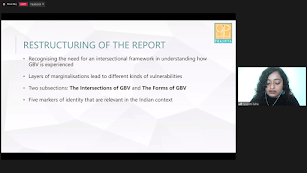
  • "Intersectionality is a framework that recognizes women are not a homogenous category and that they do not experience violence the same way...Keeping that in mind, and in our quest to make the report more intersectional, we have restructured the report very differently this year."
  • "Part I of the Report: The Intersections of Gender-Based Violence presents an overview of five markers of identity that are relevant in the Indian context: caste and indigenous identities; queerness; old age; disability; and the experiences of religious minorities"
  • "Dalit and Adivasi women face violence from the oppressor caste due to their caste/indigenous status and their gender and within their own community due to their gender identity. This is called double marginalisation. Additionally,
  • all kinds of gender-based violence have an element of power attached to them. When we look at violence against Dalit and Adivasi persons, it is a demonstration of power and a weapon to reinforce the existing structural hierarchies."
  • "There is also a large amount of symbolic violence that the queer population faced. This is in the form of non-recognition of their queer identities like the usage of wrong pronouns or deadnaming queer individuals."
  • "There is little to no research on sexual violence against elderly women due to the shame and the stigma associated with it."
  • "Women with disabilities are often financially and socially dependent on others for their survival and the perpetrators of violence are often caregivers, present either at homes or in institutional settings."
  • "We have seen that any kind of large-scale communal violence is almost always accompanied by an aspect of sexual violence."


Dr. Saumya Uma, professor at Jindal Global Law School and the Director, Centre for Women's Rights (JGLS) followed Kausumi's presentation with a talk on the report. Prof. (Dr.) Saumya Uma is a Professor at Jindal Global Law School and heads its Centre for Women’s Rights. She has over 28 years’ combined work experience as an academic, law researcher, lawyer, trainer, writer and campaigner on gender, law and human rights. She has served as a research consultant on human rights, with international agencies such as the United Nations Development Fund (UNDP), United Nations Office of the High Commissioner on Human Rights (UNOHCHR) and the International Commission of Jurists (ICJ). Additionally, she worked as the National Coordinator of ICC-India: the anti-impunity campaign on International Criminal Court and its relevance to India – from 2000 to 2010. Dr. Uma teaches and researches at the intersection of gender, human rights and the law. In particular, she writes on feminist jurisprudence; international criminal justice and its relevance to India; victim and witness protection; justice and accountability for mass crimes; South Asian women’s movements and the feminist envisioning of justice; human rights law and lawyering; gender-based violence and reparative justice; access to justice; social exclusion and marginalization; clinical legal education; and feminist pedagogy.


  • "One of my first observations is on the aspect of Kidnapping and Abduction of Women and Girls...If we look at the 2020 and 2021 statistics, we see a significant increase in the Kidnapping and Abduction of Women and Girls, and in the Kidnapping and Abduction of Women to compel her for Marriage.....Partly, this increase (in reported cases) could be due to the increased incidence of kidnapping and abduction, but there may also be cases of more inter-caste and inter-religious marriages or lesbian couples leaving homes which the parents register under complaints of abduction."
  • "Despite all the propaganda, resistance and the institutional reluctance to register complaints of domestic violence, there is still a sizeable number that is getting registered...In the covid years, when women were trapped in their homes because of lockdowns and working from home, worldwide, domestic violence increased during those years. So, the 2022 statistics are likely to show this kind of increase."
  • "There are forms of cyber-stalking which are not only by strangers but also by partners. I think this is just increasing the violence that takes place. We need to remember that stalking, rape and murder are all quite linked and there are many cases where stalking, when not stopped or prevented, has led to rape and murder."
  • "For women who were working from home, colleagues were contacting them through cyberspaces. There were forms of sexual violence at workplaces that call for the expansion of the definition of workplace to include homes as well."
  • "We need to look at domestic violence, intimate partner violence, patriarchy, misogyny, Indian masculinity, and the everyday violence that women are facing in relationships. I see and hear of these from my students as well. We think that the younger generation is very liberated in some sense, but they too are in the same trap of patriarchy and misogyny to a large extent."
  • "It is important to look at the violence inflicted on transgender women, lesbian women, gender non-confirming individuals, gender non-binary individuals...The kind of shame, stigma and institutional apathy against them is so much more, and yet it is undocumented."
  • "There are limitations in the law. The law is slow to catch up and the interpreters of the law are much slower to catch up with what is happening. So, while the law may be a part of the solution, what is really needed is social consciousness and political action."

Prajnya’s Gender Violence in India Report has been taking stock of the state of gender violence in India since 2009. The report is meant to be used as a ready reference for activists, journalists, students, lawyers and anyone with an interest in gender justice. You can access the Prajnya Gender Violence in India Report 2022 here.


Tuesday, November 15, 2022

12

And the curtain rises on Prajnya's 12th 16 Days Campaign against Gender Violence since 2008. As you know, we do three in a row and take a sabbatical. What a run, what a ride it's been!

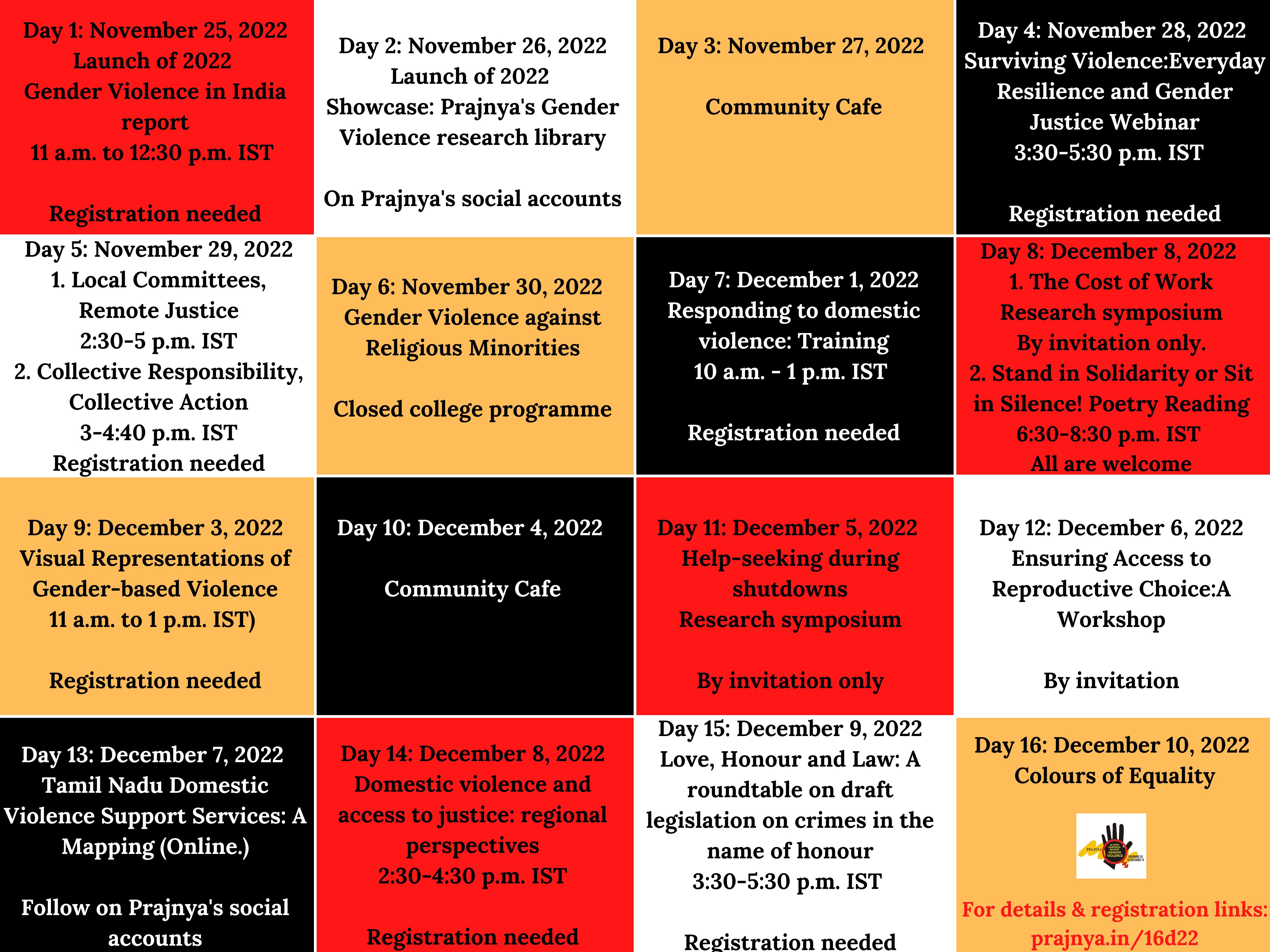
This year, we started the planning season absymally short of funds and so Prajnya's core managing team--Nandhini Shanmugham, Shakthi S. and ACR Sudaroli, and me--decided to handle the campaign ourselves. This meant limiting our runaway ambitions to what we could actually handle and what we could actually afford. Still, we present to you a pretty ambitious calendar of online and offline programmes, including our all-time favourite, the poetry reading and an on-the-sport art event for children. 


Check out the calendar here and register for the events you want to attend. And of course, remember to subscribe to this blog for updates! 

Swarna Rajagopalan on behalf of the Campaign Team

Friday, December 31, 2021

2021 Curtains!

 Curtains down on the 2021 Campaign. We're a pack of exhausted and wounded soldiers still! And looking forward to a hybrid campaign in 2022.... inshallah!